Gluten-Free Mascara: What Is Actually in Yours
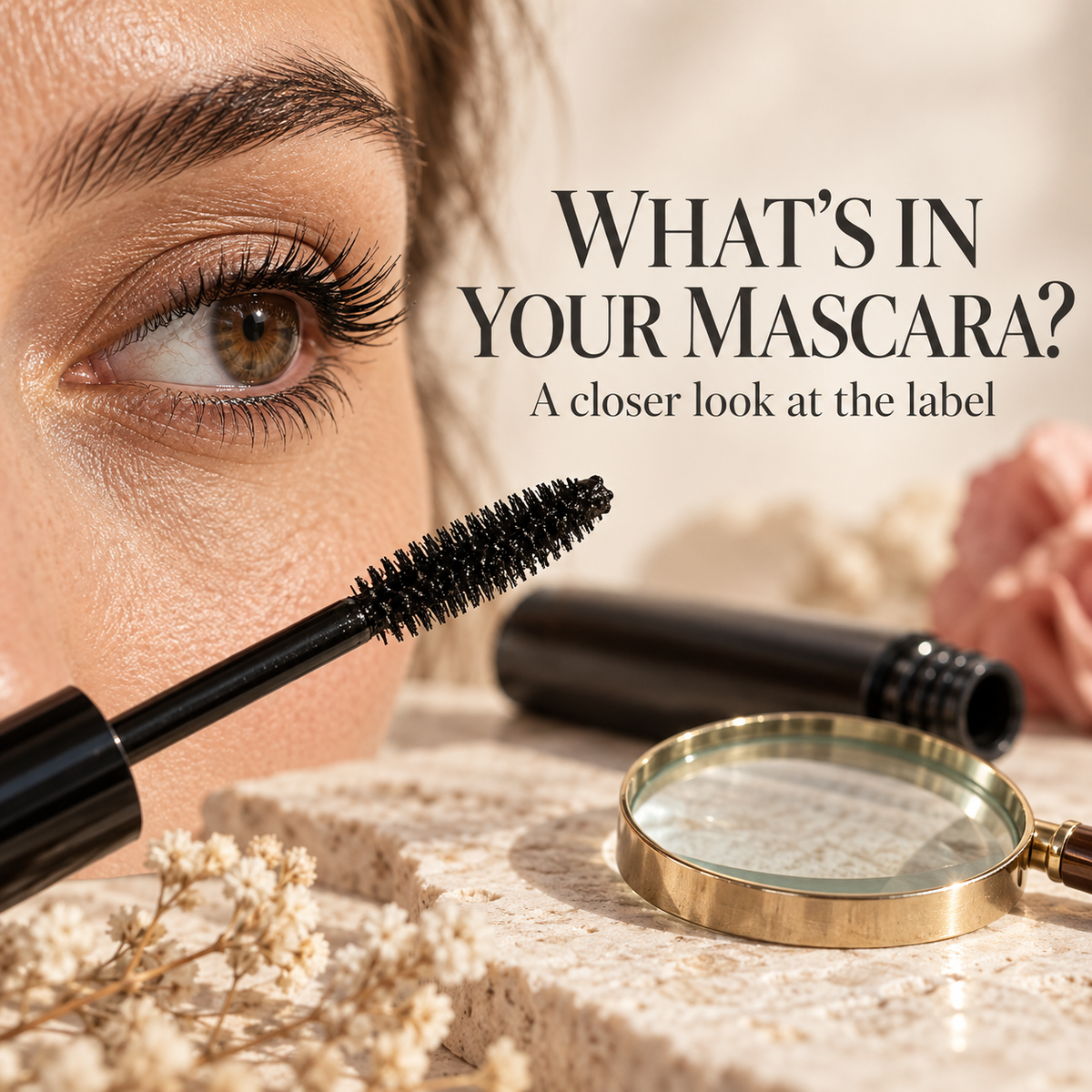
Hydrolysed wheat protein is one of the most common film-formers in mascara, and it is almost never flagged as an allergen. Cosmetics are not covered by food allergen labelling law, so wheat appears as "hydrolyzed wheat protein" or "Triticum vulgare" with no warning attached.
For anyone with celiac disease, that matters more on the eye than almost anywhere else.
Written by Dr. Liia Ramachandra, PharmD, PhD — pharmacist, formulator and founder of EpiLynx.
Why mascara is a higher-risk category
Three reasons stack up:
- The eyelid has the thinnest skin on the body — roughly 0.03 mm, against 0.1 mm on the cheek. Whatever you apply there penetrates faster.
- The tear duct drains into the nose and throat. Anything that reaches the waterline is carried onto mucosal surfaces, bypassing the skin barrier entirely.
- Hand-to-eye-to-mouth transfer is constant and unconscious.
Which is why our Volume Mega Mascara was built without a single gluten-containing ingredient, rather than as a reformulation of a standard base.
The wheat derivatives that show up in mascara
- Hydrolyzed wheat protein — a film former and lash-thickening additive. The most common one.
- Wheat amino acids — conditioning agents in long-wear formulas.
- Triticum vulgare germ oil — an emollient in cream and tubing formulas.
- Tocopherol (vitamin E) — frequently derived from wheat germ, and the source is rarely disclosed.
- Hydrolyzed wheat starch — occasionally a viscosity modifier.
The other things worth checking while you are reading the label
- Shellac — a resin secreted by the lac insect. A known contact allergen, and not vegan.
- Latex — in some tubing mascaras and most lash glues. Cross-reacts with banana, avocado, kiwi and chestnut.
- Formaldehyde releasers — DMDM hydantoin, imidazolidinyl urea, quaternium-15.
- Fragrance — yes, in mascara. It is legal and it is the number one cause of eyelid dermatitis.
- Nickel — a trace contaminant in some dark pigments.
Tubing, waterproof or regular?
Tubing formulas wrap each lash in a polymer sleeve and slide off with warm water. They are the gentlest at removal, which matters because most eyelid damage happens when you take makeup off, not when you put it on.
Waterproof needs an oil-based remover — and if that remover is not itself allergen-free, you have introduced a second exposure.
Regular is fine if you remove it by soaking rather than scrubbing.
How to remove mascara without damaging your lids
- Saturate a pad and hold it against closed lids for 20 seconds. Do not scrub.
- Wipe downward and inward. Never drag outward toward the temple — that is how lid skin stretches permanently.
- Follow with a gentle cleanser, then eye cream on damp skin.
What I actually reach for
- Volume Mega Mascara — no wheat derivatives, no shellac, no latex, fragrance-free.
- Black Mascara for Length and Volume — when you want definition over volume.
- Gentle Hydrating Facial Cleanser — removes without a second allergen exposure.
- Ultra Renewal Eye Cream — for lids that are already irritated.
Gluten-free from raw material to finished goods, made in an allergen-aware facility. Shipping is free over $39, and EPILYNXGLOW25 takes 25% off.
Frequently asked questions
Does mascara contain gluten? Frequently. Hydrolysed wheat protein is a common film former, and cosmetics are not required to declare food allergens in plain language.
Can gluten in mascara affect celiac disease? It cannot penetrate intact skin, but mascara sits millimetres from the tear duct and is partly transferred to the mouth. That is a real exposure route worth removing.
What is the safest mascara for sensitive eyes? Fragrance-free, no shellac, no latex, no formaldehyde releasers — and removed by soaking rather than scrubbing.
Is tubing mascara better for allergic eyes? Usually, because it slides off with warm water and needs no oil remover or rubbing.
Why do my eyes water fifteen minutes after applying mascara? Most often fragrance, a formaldehyde releaser, or liner on the waterline blocking the glands that make your tear film.
Keep reading
- Why Mascara Is the #1 Trigger for Cosmetic Eye Allergies
- Gluten-Free Eyeliner for Celiac Disease
- Why Your Eyeliner Stings
Educational information from a pharmacist, not medical advice.