Gluten-Free Eyeliner for Celiac Disease: What's Actually in Your Eye Makeup
Why eye makeup is a special category for celiac patients
When celiac patients evaluate skincare safety, they focus on leave-on facial products: moisturizers, serums, face creams. Eyeliner is frequently overlooked — and this is a clinical error, because eyeliner occupies a uniquely high-risk anatomical position.
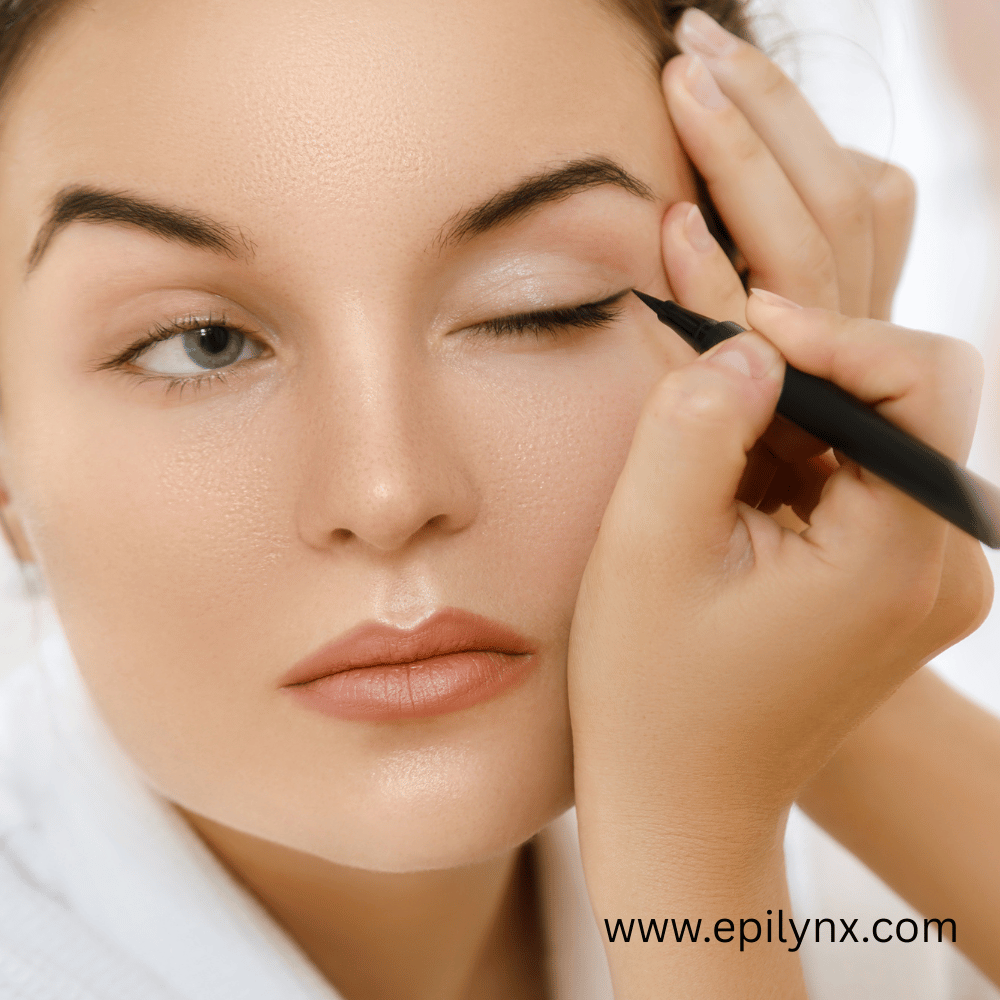
The skin of the eyelid has the thinnest stratum corneum of any area on the body, roughly 0.03 mm, compared with 0.1 mm on the face and up to 0.6 mm on the palms. That dramatically increases the bioavailability of anything applied there. Which is why we made our Waterproof Liquid Eyeliner Pen with no gluten-containing ingredient at all — not a reformulated version of a standard base.
Three anatomical risk factors
- Periocular permeability: the thin stratum corneum, high vascular density and rich lymphatic drainage create conditions for rapid penetration of smaller peptide fragments — such as hydrolyzed wheat protein — through even an intact barrier.
- Lacrimal-nasal mucosal continuity: the nasolacrimal duct connects the inner corner of the eye to the nasal mucosa. Product applied to the waterline or inner corner is carried into nasal and pharyngeal mucosal surfaces via tear film drainage — a direct mucosal exposure route that bypasses the skin barrier entirely.
- Hand-to-mouth transfer: eyeliner application followed by any hand-to-face behaviour, which is nearly universal, creates additional ingestion pathways.
Wheat derivatives found in commercial eyeliners
- Hydrolyzed wheat protein — a film-forming agent and lash-thickening additive in both pencil and liquid formulations.
- Triticum vulgare germ oil — an emollient carrier in cream eyeliners and waterline kohl products.
- Wheat amino acids — hydrolysate derivatives used for conditioning in long-wear formulas.
- Tocopherol (vitamin E) from wheat germ — an antioxidant stabilizer in pigment suspension formulas. Source is not always disclosed.
- Hydrolyzed wheat starch — occasionally used as a viscosity modifier in gel liners.
Shimmer versus matte: does format matter?
The base chemistry differs, and it affects gluten risk in a non-intuitive direction. Matte eyeliners often require film-forming agents for flat, consistent colour, and hydrolyzed wheat protein is a common choice. Shimmer formulas rely on mica, bismuth oxychloride and synthetic fluorphlogopite, and may use different carrier bases. That does not make shimmer categorically safer — both require individual INCI scrutiny.
Long-wear formulas and the two-step exposure problem
Long-wear and waterproof eyeliners often rely on acrylates or silicone film formers, which are generally not gluten-derived. However, the adhesion primers and conditioning agents in long-wear bases may include wheat derivatives. And removal requires oil-based removers, which if not allergen-free introduce a second gluten exposure during cleansing. Both the eyeliner and the remover need to be confirmed gluten-free.
What to look for in a celiac-safe eyeliner
- No hydrolyzed wheat protein, wheat amino acids or Triticum vulgare derivatives anywhere in the INCI list
- No Hordeum vulgare (barley) or Secale cereale (rye)
- Tocopherol from non-wheat origin — soy, sunflower or synthetic
- Fragrance-free, because fragrance in periocular proximity is a high sensitization risk
- Manufactured in an allergen-aware facility with documented cross-contamination controls
What I actually reach for
- Waterproof Liquid Eyeliner Pen — no gluten-containing ingredient, fragrance-free.
- Glide-On Gel Eyeliner Pencil — for a softer line without dragging the lid.
- Gentle Hydrating Facial Cleanser — removes eye makeup without a second allergen exposure.
- Ultra Renewal Eye Cream — for lids that are already irritated.
All produced in an allergen-aware Los Angeles facility, gluten-free from raw material to finished goods. Shipping is free over $39, and EPILYNXGLOW25 takes 25% off.
Keep reading
- Why Your Eyeliner Stings
- Best Waterproof Eyeliner for Sensitive Eyes
- Gluten in Skincare: A Celiac Ingredient Guide
Educational information from a pharmacist, not medical advice.