The Sensitive Skin Sunscreen Guide: Why Mineral SPF Is the Only Safe Choice
Sunscreen is the single most important anti-aging and skin-protective product you can use. Every dermatologist agrees on this. Every piece of research supports it. And yet, for people with sensitive skin, eczema, rosacea, psoriasis, or contact allergies, finding a sunscreen they can actually wear every day without reacting to is a genuinely difficult problem.
The white cast of most mineral sunscreens has been an excuse not to wear them. The elegant texture of chemical sunscreens has been a reason to reach for them instead. But for sensitised skin — and for anyone paying attention to what is actually in their products — the choice is not really a choice at all. Mineral sunscreen is the only option that makes pharmacological and safety sense.
Here is everything you need to know to find one you will actually wear.
How Sunscreen Works: Chemical vs. Mineral
There are two fundamentally different mechanisms by which sunscreens protect skin from UV radiation.
Chemical sunscreens work by absorbing UV radiation and converting it into heat energy, which is then released from the skin. The active ingredients — oxybenzone, avobenzone, octinoxate, octisalate, octocrylene, homosalate, and others — must be absorbed into the skin to function. This absorption is not incidental; it is mechanistically required. These compounds are active inside the skin cells, not on the surface.
Mineral sunscreens work by sitting on the surface of the skin and physically reflecting and scattering UV radiation before it can penetrate. The two approved mineral UV filters — zinc oxide and titanium dioxide — work on the skin's surface and are not absorbed to any meaningful degree.
This distinction matters enormously for sensitive skin.
Why Chemical Sunscreen Filters Are Problematic for Sensitive Skin
Contact allergy and photoallergy
Several chemical UV filters are recognised contact allergens. Oxybenzone (benzophenone-3) is one of the most frequently identified causes of sunscreen-related contact dermatitis. Avobenzone, while not as common an allergen as oxybenzone, can cause both contact and photocontact allergy (a reaction triggered by UV activating the allergen in the skin).
For people with rosacea, eczema, or known contact allergies, chemical sunscreen filters represent a meaningful allergen burden. EpiLynx formulates without all chemical UV filters for exactly this reason.
Hormonal and systemic concerns
In 2019, the FDA published research showing that six common chemical sunscreen ingredients — oxybenzone, avobenzone, octocrylene, homosalate, octisalate, and octinoxate — were absorbed into the bloodstream at levels significantly above the FDA's threshold for systemic safety investigation. A subsequent 2020 FDA study confirmed that oxybenzone in particular accumulates in the body and is detectable in blood, urine, and breast milk after topical application.
The FDA currently classifies only zinc oxide and titanium dioxide as "generally recognized as safe and effective" (GRASE). Chemical filters remain in a regulatory grey zone pending further safety studies.
Heat generation on reactive skin
Chemical sunscreens generate heat as they convert UV energy — an inherent consequence of how they work. For rosacea skin, which is already prone to heat-triggered flushing, or for eczema skin in a state of active inflammation, this additional heat generation can worsen symptoms. Mineral sunscreens do not generate heat.
The White Cast Problem — And Why It Is Largely Solved
The historic barrier to mineral sunscreen adoption has been the white cast — the chalky, ghost-like appearance of zinc oxide and titanium dioxide on skin, particularly deeper skin tones. This was a legitimate concern with first-generation mineral formulations, where large zinc oxide particles sat visibly on the skin surface.
Modern mineral sunscreen formulations use micronised or nano-sized mineral particles that are significantly more transparent on skin while retaining their UV-filtering properties. Current evidence from the FDA and independent researchers suggests that nano-zinc oxide and nano-titanium dioxide do not penetrate intact skin to a meaningful degree, addressing the main concern about particle size reduction.
Additionally, tinted mineral sunscreens use iron oxide pigments to neutralise the white cast while simultaneously providing protection against visible light (HEV light), which can worsen hyperpigmentation and melasma even when UV protection is adequate.
For people who have avoided mineral SPF because of white cast: the current generation of formulations is categorically different from what was available five years ago. It is worth trying again.
Ingredients to Avoid in Sunscreens for Sensitive Skin
Beyond the chemical UV filters themselves, sensitised skin shoppers need to watch for additional irritants common in sunscreen formulations:
- Fragrance — common in sunscreens to make them more pleasant to apply; a significant allergen for sensitive skin
- Alcohol denat — used to improve texture and drying time; strips the skin barrier
- Oxybenzone — the most common chemical sunscreen allergen; not present in mineral formulations
- Avobenzone — less common allergen but a photosensitiser for some people
- Retinyl palmitate — a vitamin A derivative once widely used in sunscreens; concerns about photosensitivity in high concentrations (the FDA has raised questions about its use in SPF products specifically)
- Benzophenone-2, -3, -4 — benzophenone family members are common allergens even outside of UV-filtering use
- PABA (para-aminobenzoic acid) — now largely eliminated from modern sunscreens due to its high sensitisation rate, but worth checking in older formulations
Understanding SPF Numbers for Sensitive Skin
SPF measures protection against UVB rays (the primary cause of sunburn and a significant factor in skin cancer). The relationship between SPF numbers and protection is not linear:
- SPF 15 blocks approximately 93% of UVB rays
- SPF 30 blocks approximately 97% of UVB rays
- SPF 50 blocks approximately 98% of UVB rays
- SPF 100 blocks approximately 99% of UVB rays
For people with photosensitive conditions (rosacea, lupus, certain medications) and for daily urban use, SPF 30–50 is the standard recommendation. Higher SPFs give marginally more protection but require more active ingredient, which can mean more potential irritants in the formula.
UVA protection — the rays responsible for aging, hyperpigmentation, and deeper skin damage — is not measured by the SPF number in the US. Look for the words "broad spectrum" on the label, which indicates the product meets FDA standards for UVA protection. Zinc oxide is one of the best broad-spectrum UV filters available, providing excellent UVA coverage alongside UVB protection.
How to Apply Mineral Sunscreen for Maximum Protection
Sunscreen is the most commonly misapplied skincare product. These are the most important things to know:
Amount: Most people apply 20–50% of the recommended amount of sunscreen. The FDA standard of 2mg/cm² translates to approximately one teaspoon (5ml) for the face and neck, or a shot glass (30ml) for the full body. Using less SPF means getting less than the labelled protection.
Timing: Mineral sunscreens can be applied immediately before sun exposure — they work by physically blocking UV from the moment of application, unlike chemical sunscreens which need 15–20 minutes to be absorbed before providing full protection.
Reapplication: Every 2 hours during sun exposure, or immediately after swimming or heavy sweating. No sunscreen lasts all day without reapplication.
Order in routine: Apply mineral sunscreen as the last step in your skincare routine, before makeup. Do not mix it into your moisturiser — diluting SPF reduces its efficacy.
The EpiLynx SPF 50 Mineral Moisturiser
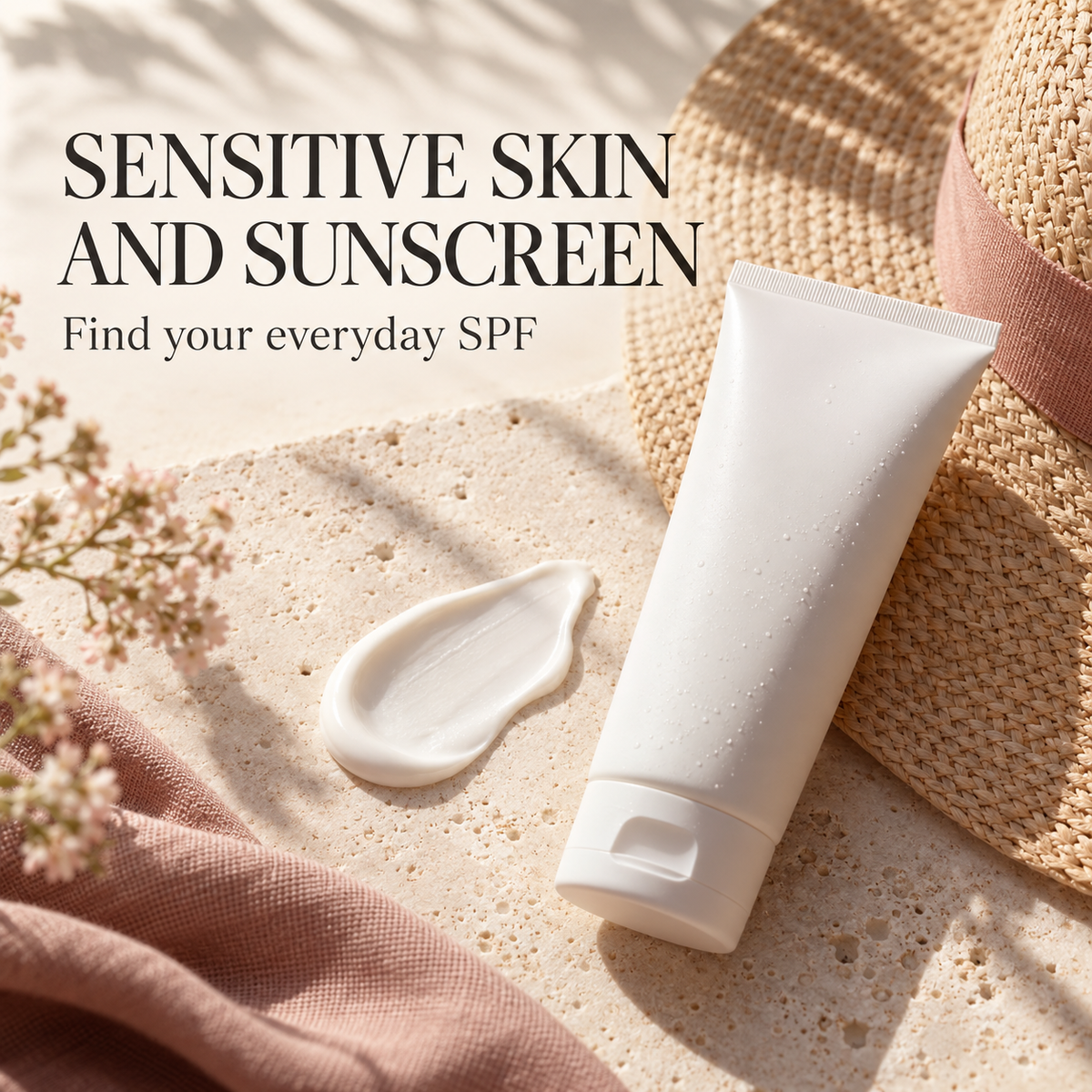
The EpiLynx SPF 50 Mineral Moisturiser uses zinc oxide as the sole UV filter — no chemical sunscreen ingredients, no oxybenzone, no avobenzone. It is formulated without fragrance, without nickel-containing pigments, and free from all 14 most common contact allergens.
It is designed to be the final step in an allergen-aware skincare routine for people who cannot compromise on what goes on their skin — people with rosacea, eczema, psoriasis, celiac disease, contact allergies, or simply the knowledge that what you put on your skin matters.
Shop the EpiLynx SPF 50 Mineral Moisturiser at epilynx.com/collections/suncare — and take the Skin Quiz to build your complete allergen-free SPF routine for your skin type.