Article: Is "Fragrance-Free" Really Fragrance-Free? What Sensitive Skin Shoppers Need to Know
Is "Fragrance-Free" Really Fragrance-Free? What Sensitive Skin Shoppers Need to Know
You have done everything right. You switched to fragrance-free products after your skin started reacting. You read labels. You chose the "sensitive" line from a brand you trusted. And yet — your skin is still flaring. Still itching. Still reactive in that maddening way that makes you question whether you are doing something wrong.
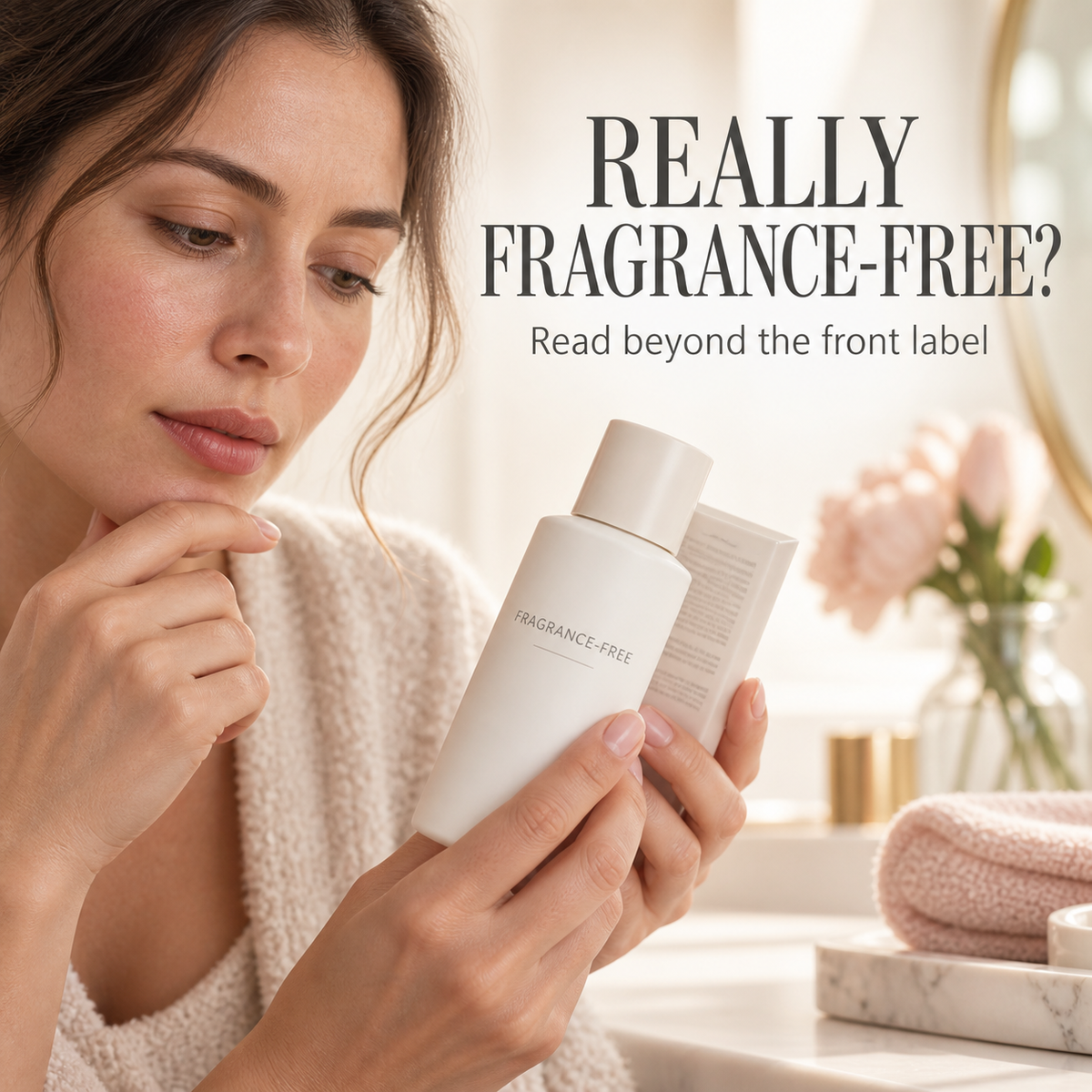
Here is what nobody tells you: "fragrance-free" does not always mean what you think it means. The term is loosely defined, inconsistently applied, and frequently misleading — and for people with genuinely sensitised skin, the gap between what the label promises and what the formula delivers can be the difference between calm skin and another miserable flare.
This guide breaks down exactly what "fragrance-free" means on a beauty label, what it misses, and what to actually look for when your skin cannot tolerate fragrance in any form.
The Regulatory Gap: Why "Fragrance-Free" Lacks a Legal Definition
In the United States, the FDA does not define or regulate the cosmetic term "fragrance-free." There is no required testing, no certification process, and no third-party verification required before a brand prints "fragrance-free" on a label.
Contrast this with food labelling, where "gluten-free" must meet a specific FDA threshold (under 20 parts per million), or "organic," which requires USDA certification. In cosmetics, brands self-determine what "fragrance-free" means to them — and that determination varies enormously.
This regulatory gap is not accidental. Fragrance formulas are protected as trade secrets under US law, meaning brands are not required to disclose the individual chemicals that make up a "fragrance" blend. This makes independent verification nearly impossible for consumers.
"Fragrance-Free" vs. "Unscented": They Are Not the Same Thing
This is one of the most important distinctions in sensitive skincare, and it is almost never explained clearly on packaging.
Fragrance-free means — in theory — that no fragrance ingredient has been intentionally added to the formula. The product may still have a natural smell from its functional ingredients (a serum with niacinamide often has a faint yeasty smell; a vitamin C product may smell slightly acidic) but no fragrance agent was deliberately included.
Unscented means that the product has no detectable scent — which often means fragrance ingredients were added, specifically to mask the natural odours of the functional ingredients. These masking fragrances are still fragrances. They are still allergens. They are just doing an invisible job.
For someone with fragrance contact allergy, an "unscented" product can cause the same reaction as an obviously perfumed one. The masking fragrances are present; they are just not doing the job of making the product smell pleasant.
Always choose "fragrance-free" over "unscented" — and then verify by reading the full ingredient list.
The Hidden Fragrance Ingredients You Need to Know
Even on products labelled "fragrance-free," fragrance-derived ingredients may appear under other names — particularly if they serve a dual function as a preservative, antioxidant, or skin-conditioning agent. Regulators consider these functional ingredients, not fragrances, so they do not need to be grouped under "fragrance" on the label.
Common hidden fragrance ingredients on "fragrance-free" products:
- Benzyl alcohol — listed as a preservative, but is also a fragrance component and a sensitiser
- Eugenol — derived from cloves, appears in "natural" formulations; a potent contact allergen
- Geraniol — a naturally occurring fragrance alcohol found in rose and geranium oil; common sensitiser
- Linalool — present in lavender, bergamot, and many other botanical extracts; one of the top contact allergens in Europe
- Limonene — found in citrus extracts and citrus-derived cleaning agents; oxidises on skin to form potent allergens
- Cinnamal — cinnamon-derived; a common sensitiser classified as a fragrance allergen by the EU
- Citronellol — found in rose and citronella; listed on the EU's 26 declared fragrance allergens
- Farnesol — a natural sesquiterpene alcohol used in floral fragrances; appears in botanical extracts
These ingredients appear on fragrance-free labels when they are sourced from botanical extracts, because the brand can argue the fragrance is incidental to the extract's other properties. For a sensitised immune system, the distinction is irrelevant. A reaction is a reaction.
"Natural" Does Not Mean Fragrance-Free (And Rarely Means Allergen-Free)
This is possibly the most dangerous misconception in the sensitive skincare space. The "natural" and "clean beauty" movement has created a powerful narrative that synthetic = bad and natural = safe. For fragrance allergens, the opposite is often true.
The EU's list of 26 declared fragrance allergens — substances that must be individually disclosed on cosmetic labels when present above certain thresholds — is composed almost entirely of naturally occurring compounds. Linalool (lavender), limonene (citrus), eugenol (clove), geraniol (rose), and cinnamal (cinnamon) are all natural. All are common sensitisers. All appear regularly in products marketed as "natural," "botanical," "plant-based," or "clean."
A person with fragrance contact allergy is often more at risk from a "natural" skincare product than from a synthetic fragrance-free pharmaceutical-grade formulation. The lavender face oil, the rose water toner, the "calming" chamomile cream — these are high-allergen products wearing a safe-sounding label.
Essential Oils and "Aromatherapy" Products: A Special Warning
Essential oils are highly concentrated botanical extracts that contain dozens to hundreds of individual chemical compounds — many of which are known contact allergens. Lavender essential oil alone contains over 100 chemical compounds, including linalool, linalyl acetate, and several terpenes that oxidise to form additional sensitisers on skin contact.
The concentration of these allergens in an undiluted essential oil is orders of magnitude higher than in a conventional fragrance blend. "Aromatherapy-grade," "pure," or "100% natural" essential oils are not safer for sensitised skin — they are among the highest-risk topical products available.
If you have fragrance contact allergy or eczema/rosacea, essential oils in any concentration should be treated with extreme caution. Patch test before every new product containing them, and when in doubt, avoid entirely.
What to Actually Look for When You Need Truly Fragrance-Free Skincare
Reading an ingredient list for hidden fragrance components requires knowing what to look for. Use this as your checklist:
Scan for these high-alert terms:
- Any ingredient ending in "-ol" that is not a well-known functional alcohol (benzyl alcohol, geraniol, citronellol, linalool, farnesol)
- Limonene, cinnamal, eugenol, isoeugenol
- Any "extract" from a fragrant plant (lavender, rose, jasmine, ylang ylang, bergamot, patchouli, sandalwood, neroli, chamomile in high concentrations)
- "Citrus aurantium," "Rosa damascena," "Lavandula angustifolia" in leave-on products
- "Parfum" or "fragrance" anywhere on the list (some products list both "fragrance-free" on the front and "parfum" buried in the ingredient list — yes, this happens)
Trust these signals:
- Brands where the founder has relevant scientific credentials and personal stake in formulating allergen-free
- Full ingredient list published and easily searchable on the website
- Independent dermatologist or allergy testing certificates available on request
- Free from claims that cover the EU's 26 declared fragrance allergens specifically
The EpiLynx Standard for Fragrance-Free
At EpiLynx, "fragrance-free" means the entire EU list of 26 declared fragrance allergens is absent from every formula — not just the word "fragrance" from the label. Dr. Liia formulates without synthetic fragrance blends, without masking fragrances, and without the high-sensitisation botanical extracts that commonly appear in "natural" sensitive skin products.
The scent that comes from EpiLynx products is derived from fresh berry extracts used for their functional antioxidant properties — not for fragrance. This is a meaningful distinction that the label "fragrance-free" alone does not capture.
Building a Truly Fragrance-Free Routine
Cleanser: Look for a short ingredient list with no botanical extracts from fragrant plants. The EpiLynx Gentle Hydrating Facial Cleanser is built around aloe vera and cucumber — two botanicals with excellent sensitive-skin safety records and no significant fragrance allergen profile.
Serum: Niacinamide, hyaluronic acid, and peptide serums are generally the safest choices — the functional ingredients themselves are not fragrance allergens. Avoid vitamin C serums that use citrus-derived ascorbic acid extraction processes if you are highly sensitised.
Moisturiser: Choose creams and gels with no listed botanical extracts from fragrant plants. Avoid "soothing" products that rely on lavender, chamomile, or rose for their calming claims.
SPF: Mineral-only sunscreens (zinc oxide, titanium dioxide) are generally fragrance-allergen-free. Be cautious with "fresh" or "light" sunscreen formulations that may use citrus or botanical extracts for a pleasant application experience.
Makeup: This is where hidden fragrance is most prevalent. Even "natural" makeup brands routinely use fragrant botanical extracts for skin benefit or texture. Stick to brands where fragrance-free is a formulation philosophy, not just a label claim.
Every EpiLynx product is formulated without the EU's 26 declared fragrance allergens — not just without the word "fragrance" on the label. Take the EpiLynx Skin Quiz at epilynx.com to build a routine that is genuinely safe for your sensitised skin.