Article: Nickel Allergy and Skincare: The Hidden Trigger No One's Talking About
Nickel Allergy and Skincare: The Hidden Trigger No One's Talking About
You know to avoid costume jewellery. You have swapped your metal watch buckle for a plastic one. You have even replaced your jeans buttons after a classic nickel allergy rash bloomed across your stomach. But are you still wondering why your face is reactive, your eyelids are itchy, and your skin near your cheeks keeps flaring — even though you are meticulous about your diet and your metals?
If this sounds like you, your skincare could be the missing piece of the puzzle.
Nickel allergy is the most common contact allergy in the general population — affecting up to 19% of women and 3% of men. Most people think of it purely as a jewellery problem. Almost nobody thinks about skincare. And yet pigments, metallic packaging, and trace mineral contamination mean nickel can be present in your foundation, your eye shadow, your face cream, and your sunscreen without anyone putting it on the label.
Why Nickel Ends Up in Skincare
Pigments and Colourants
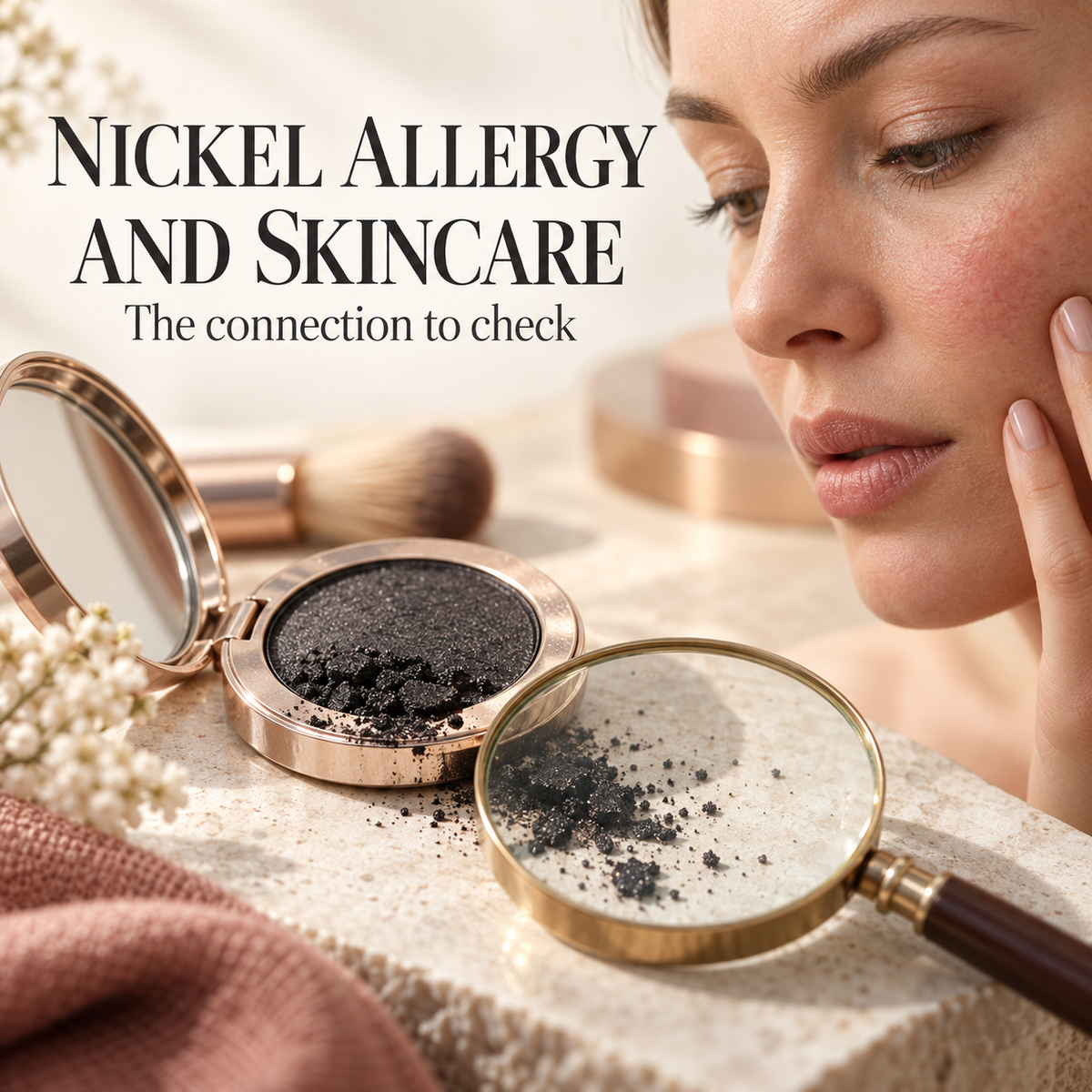
This is the most significant source. Many of the inorganic pigments used in makeup — particularly shimmer, highlight, and bronzer products — are derived from mica and iron oxides that naturally contain trace levels of nickel as a contaminant. The more metallic, shimmery, or sparkling a product appears, the higher the potential nickel content.
High-risk products include: bronzers, highlighters, metallic eye shadows, pearlescent foundations, gold or silver nail polish, and glitter-infused products.
Metallic Packaging and Applicators
Nickel is used in metal alloys that appear in product packaging — metal palettes, lipstick cases, mascara tubes, and applicators with metal tips. When products are stored in nickel-containing containers, transfer can occur, particularly with oils and serums.
Trace Contamination in Mineral Ingredients
Kaolin clay, talc, zinc oxide, and titanium dioxide — all common in "natural" and mineral cosmetics — can contain trace nickel from geological sources. Reputable suppliers test for heavy metal contamination and provide certificates of analysis. Not all suppliers do this, particularly in lower-cost supply chains.
Recognising Nickel Contact Dermatitis on the Face
Facial nickel dermatitis presents differently to the classic nickel rash from jewellery. Instead of a clear outline matching a watch strap or necklace, facial reactions tend to be:
- Diffuse redness and irritation across the cheeks and forehead (often attributed to rosacea)
- Persistent itching or burning on the eyelids — particularly the outer corners — that is worse after applying eye makeup
- Rough, thickened skin (lichenification) in areas of repeated contact with the triggering product
- Periorbital dermatitis — a rash around the eyes often mistaken for allergic conjunctivitis
Because facial nickel dermatitis does not follow the distinctive patterns of jewellery-related allergy, it frequently goes misdiagnosed as rosacea, seborrhoeic dermatitis, or simply "sensitive skin." Patch testing by a dermatologist or allergist is the gold standard for confirmation.
The Food-Skin Connection in Nickel Allergy
People with significant nickel sensitisation may also benefit from managing dietary nickel. High-nickel foods include whole grains (oats, whole wheat, brown rice), legumes (lentils, beans, chickpeas), nuts and seeds, dark chocolate, shellfish, and leafy green vegetables.
A low-nickel diet is rarely necessary for most people with contact allergy, but for those with severe, widespread reactions or dyshidrotic eczema (a specific type of eczema linked to nickel ingestion), dietary reduction alongside topical avoidance can be meaningful.
This intersection of food and skincare allergens is one reason EpiLynx was designed to be free from both nickel and gluten — two allergens that affect the same sensitive populations and require vigilance in both food and cosmetics.
Reading Ingredient Labels for Nickel: The Honest Truth
Here is the difficult reality: nickel does not appear on cosmetic ingredient labels. It is present as a trace contaminant, not an added ingredient. You cannot identify nickel exposure by reading a product label in the normal way.
What you can do:
- Avoid shimmer and metallic makeup products, which carry the highest pigment-related nickel risk
- Choose skincare and makeup brands that specifically test for heavy metal contamination and formulate nickel-free by intention
- Use a nickel test kit (dimethylglyoxime test, available from pharmacies and online) on metal packaging and applicators — a pink colour indicates nickel release
- Contact brands directly and ask for certificates of analysis for heavy metals in their formulations
EpiLynx tests all formulations and sources ingredients specifically to ensure nickel remains below safe thresholds. Our nickel-free commitment is by pharmacist design, not assumed from ingredient list review alone.
The Nickel-Free Skincare Routine: Step by Step
Morning
Cleanser: Use a gentle, fragrance-free face wash without shimmer or metallic ingredients. The EpiLynx Gentle Hydrating Facial Cleanser uses aloe, cucumber, and antioxidants — no pigments, no nickel risk.
Serum: Choose a clear or pale-coloured serum. Avoid serums containing mica-based shimmer particles (sometimes marketed as "luminising" or "glow" serums).
Moisturiser: Plain, uncoloured moisturisers carry minimal nickel risk. The EpiLynx Lightweight Face Moisturiser for Sensitive and Dry Skin is formulated without any pigments or metallic elements.
SPF: Mineral sunscreens (zinc oxide, titanium dioxide) sourced from suppliers with heavy metal testing are generally safe for nickel allergy. The EpiLynx SPF 50 Mineral Moisturiser is sourced with nickel-free supply chain documentation.
Evening
Makeup removal: Use a non-metallic applicator — soft cloth or clean fingers rather than metal spatulas. The EpiLynx Jojoba Oil Makeup Remover Balm uses a simple, nickel-free formula.
Eye cream: The EpiLynx Anti-Aging Peptide Eye Cream uses no shimmer pigments and is formulated free from nickel and all 14 common allergens.
Night cream: Focus on barrier repair — ceramides, hyaluronic acid, peptides. Avoid anything with metallic particles.
Makeup
This is where the most vigilance is needed for nickel allergy:
- Foundation: Choose matte or satin finish — glow finishes often contain mica
- Concealer: Matte formulas are safer than illuminating or brightening concealers
- Eye shadow: Stick to matte shades; avoid shimmer, glitter, and metallic shades entirely
- Eyeliner: Choose pencil or gel formulas; avoid metallic liquid liners
- Blush and bronzer: Matte formulations from brands that test for heavy metals
- Highlighter: If you have significant nickel allergy, highlighter is the highest-risk category and may be best avoided entirely
Patch Testing for Nickel: What to Know
Standard patch testing for nickel allergy uses a nickel sulfate preparation applied under an occlusive patch for 48 hours, then read at 48 and 72 hours. This is done by a dermatologist or allergist and is the definitive test.
If you have not been formally patch tested but suspect nickel allergy based on your history, seeing a dermatologist is worth the investment. Nickel sensitisation tends to worsen with repeated exposure — the sooner you identify and eliminate sources, the better.
Living with Nickel Allergy: Practical Tips
- Keep a product diary: note every product you use and any skin reactions, however minor
- Go through your makeup bag and test every metal container or applicator with a nickel test kit
- Replace metal tweezers, eyelash curlers, and applicators with nickel-free alternatives
- Inform your hairdresser — hair dye applicator brushes with metal handles are a common but overlooked exposure
- When travelling, test hotel water quality if you notice worsening skin — high iron/nickel content in local water can affect skin
EpiLynx is formulated nickel-free and free from all 14 most common contact allergens. Build your nickel-free routine at epilynx.com or take the Skin Quiz for personalised recommendations from Dr. Liia.