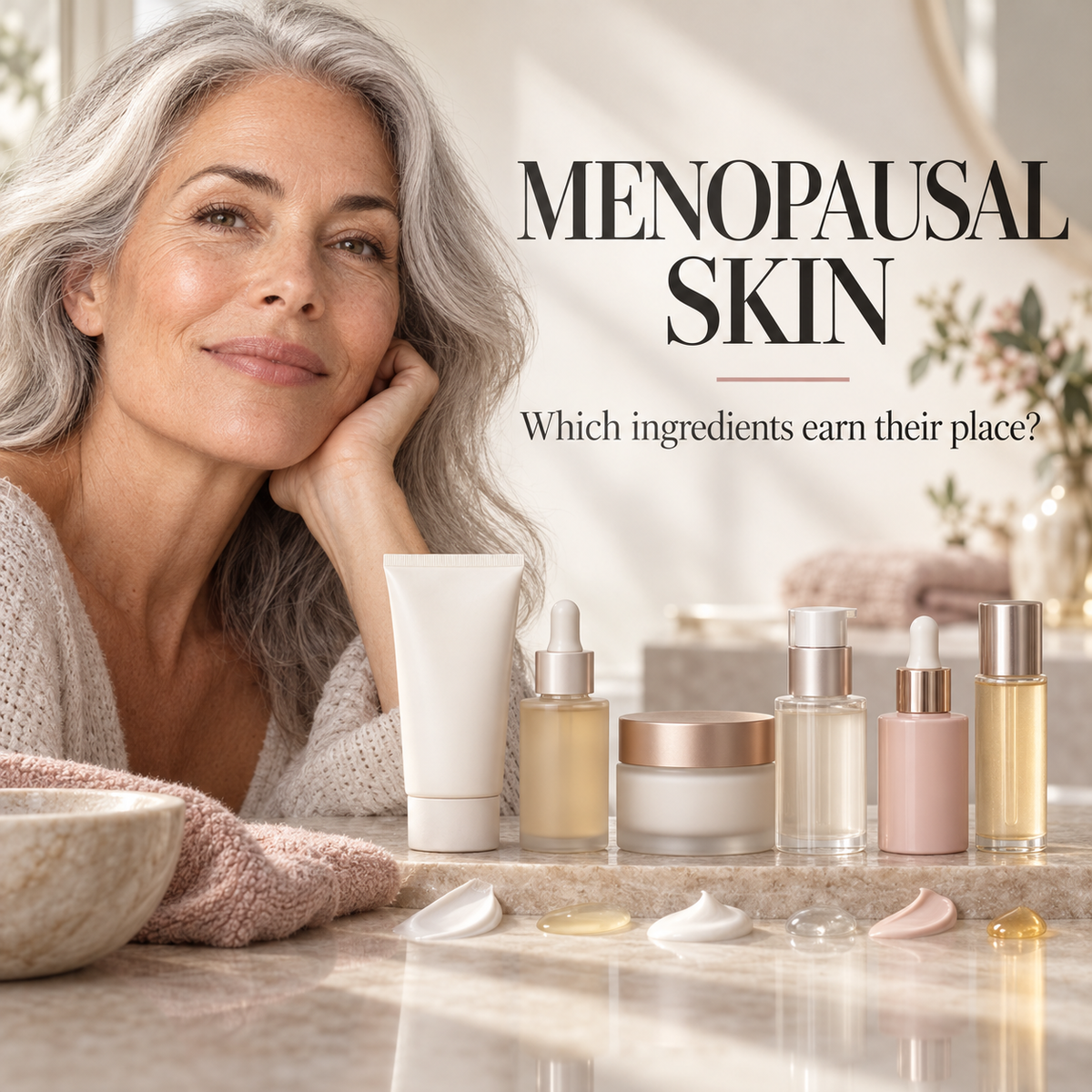
The Best Ingredients for Menopausal Skin, Ranked by Evidence
Menopausal skin has four specific problems: falling collagen, depleted barrier lipids, reduced water-holding capacity, and increased pigmentation. Every ingredient below is judged on how well it addresses those, and on how well the evidence actually holds up.
Tier 1 — strong evidence, use these
1. Broad-spectrum sunscreen
Not glamorous, and the highest-return thing on this list by a wide margin. UV activates the enzymes that break down collagen — the same enzymes oestrogen used to suppress. Sunscreen is now doing a job your hormones stopped doing. It also prevents pigmentation, which is one of the four core problems.
Look for: SPF 50, mineral if you flush or are sensitive, tinted if you have any pigmentation — iron oxides block visible light, which plain sunscreen does not.
2. Retinoids
The best-evidenced topical for collagen, full stop. Upregulates procollagen production, inhibits the enzymes that degrade it, and normalises turnover. Also treats the hormonal acne and the pigmentation — three of the four problems with one product.
The menopausal caveat: thinner, more reactive skin means aggressive use backfires. Two nights a week, buffered over moisturiser, sustained for a year, beats nightly for a fortnight.
3. Ceramides, cholesterol and fatty acids
These are literally the lipids you have stopped producing. Replacing them directly addresses dryness (64% of women), itching (56%) and the new sensitivity that appears from nowhere. One intervention, three symptoms.
4. Glycerin
The most reliable humectant there is, effective at almost any concentration, and essentially non-irritating. Unfashionable because it is cheap. It works.
Tier 2 — good evidence, worth including
5. Niacinamide
Increases ceramide synthesis, reduces water loss, calms inflammation, blocks pigment transfer, and is tolerated by almost everyone at 2 to 5%. Above roughly 10% it causes flushing in some people — more is not better.
6. Vitamin C
An essential cofactor for collagen cross-linking — without it collagen cannot assemble properly — plus antioxidant protection and tyrosinase inhibition for pigment. Sensitive skin usually does better with a lower percentage or a derivative than with 20% L-ascorbic acid.
7. Hyaluronic acid
Replaces topically what the dermis is no longer producing. Only works applied to damp skin and sealed on top — otherwise it draws water from deeper layers and evaporates, leaving you drier. This is why so many people say it does nothing.
8. Peptides
Can stimulate fibroblast activity. Evidence is real but more modest than retinoid data and varies hugely by specific peptide. Their strength is tolerability — genuinely useful where retinoids are not, and around the eyes.
9. Azelaic acid
The most underrated ingredient for this age group. Treats pigmentation, adult acne and redness simultaneously, is well tolerated on reactive skin, and is pregnancy-safe. If you can only add one active beyond a retinoid, consider this.
Tier 3 — useful in specific situations
- Urea, 5 to 10% — humectant plus mild keratolytic. Excellent on shins, elbows and thickened dry body skin. Stings above 10% on cracked skin.
- Lactic acid — the gentlest AHA. Long-term use has modest evidence for improved dermal thickness. Better tolerated than glycolic.
- Mandelic acid — larger molecule, slower penetration, the best-tolerated exfoliant for reactive menopausal skin.
- Kojic acid — effective on pigmentation, gentler than hydroquinone.
- Panthenol — soothing, supports barrier repair, very low irritation risk.
- Centella asiatica — good evidence for calming and barrier support.
- Squalane — a well-tolerated emollient that mimics skin’s own lipids and does not feed the yeast involved in seborrheic dermatitis.
Skip or approach carefully
- Glycolic acid at high strength. A common rosacea trigger, and rosacea frequently starts in this decade. Too aggressive for most thinning skin.
- Physical scrubs. No benefit, real harm to a thinning barrier.
- Fragrance and essential oils. A permeable barrier means these now reach living tissue. This is the leading cause of the sudden sensitivity so many women describe.
- Alcohol denat. Strips the lipids you are short of.
- Topical collagen. The molecule cannot penetrate. It is a decent humectant and nothing more.
- "Plant oestrogen" cosmetics. If a topical genuinely had oestrogenic activity strong enough to change your skin, it would be a regulated drug.
- Stacking three actives. The most common self-inflicted problem at this age.
How to combine them without wrecking your face
- Morning: vitamin C, moisturiser with ceramides and niacinamide, SPF.
- Night: retinoid two nights a week, buffered. Peptides or azelaic acid on other nights. Rich cream over everything.
- Weekly at most: lactic or mandelic acid, never on a retinoid night.
- Always: humectant on damp skin, occlusive on top.
- Never: two new actives in the same fortnight.
Where to find each of these
- Sunscreen: SPF 50 Mineral Moisturizer / Tinted CC SPF 55
- Retinoid: Wrinkle Repair Retinol Night Cream
- Barrier lipids: Rich Calming Cream
- Hyaluronic acid: Sunrise Hyaluronic Acid Serum
- Vitamin C: Brightening Vitamin C Glow Serum
- Peptides: Anti-Aging Peptide Eye Cream
- Pigment: Brightening Tone Repair Cream / Kojic Acid Cream
- Mature Skin and Serums & Treatments
Educational information from a pharmacist, not medical advice.