Article: Allergen-Free Skincare for Children with Eczema and Food Allergies: A Parent's Guide
Allergen-Free Skincare for Children with Eczema and Food Allergies: A Parent's Guide
If your child has food allergies or eczema, you already know that every product choice carries more weight than it does for other parents. You have read food labels until your eyes hurt. You have navigated birthday parties, school lunches, and holiday meals with the vigilance of someone managing a complex medical situation — because that is exactly what you are doing.
But here is what the food allergy and eczema community does not always emphasise: the same rigour you apply to what your child eats should extend to what you put on their skin. The connection between food allergies, skin barrier dysfunction, and topical product exposure is one of the most active areas in paediatric dermatology and allergy research — and the findings genuinely matter for decisions you are making today.
The Gut-Skin-Allergy Triangle in Children
In the last decade, a significant body of research has upended the traditional understanding of how food allergies develop in children. The old model assumed that allergies developed through ingestion — a child eats a food, reacts, and becomes sensitised. We now know this is not the primary pathway.
The "dual allergen exposure hypothesis" (first proposed by researchers at King's College London) suggests that food allergy sensitisation actually occurs through skin — particularly through a broken skin barrier. When a child with eczema or compromised skin barrier is exposed to food proteins (peanuts, egg, wheat, milk) through the skin — from dust in the environment, residue on surfaces, or products containing those proteins — the immune system sees them in an inflammatory context and mounts an allergic response.
This is why the LEAP trial (Learning Early About Peanut Allergy) was so groundbreaking: early oral introduction of peanuts dramatically reduced allergy development. Through the gut, peanut exposure teaches the immune system tolerance. Through broken skin, the same exposure can trigger sensitisation.
The practical implication: eczema and food allergy are not separate problems with separate solutions. They are linked through skin barrier dysfunction, and managing the skin barrier is one of the most important things you can do for a child with either condition.
Why Children's Skin Is Not Just Small Adult Skin
Children's skin — particularly in infants and toddlers — has distinct properties that make ingredient choice even more critical:
- Higher surface-area-to-body-weight ratio: Children absorb proportionally more of any topical product through their skin than adults do, increasing potential systemic exposure
- Thinner stratum corneum: The outermost barrier layer is thinner in infants, making penetration easier
- Immature detoxification pathways: A young child's liver and kidneys are still developing their ability to process absorbed chemicals — this is why certain preservatives and chemical sunscreen filters tolerated in adults are not recommended for very young children
- Higher susceptibility to sensitisation: The immune system in early childhood is in a critical programming phase; exposures during this window can establish lifelong sensitisations
Ingredients to Avoid in Children's Skincare
Fragrance — Absolutely Fragrance is the number one ingredient to eliminate from a child's skincare routine entirely. This includes "natural" fragrances like lavender, eucalyptus, tea tree, and citrus essential oils — all of which are common sensitisers in children. "Fragrance-free" is the standard, not just "unscented."
Food-Derived Allergens Many children's products contain ingredients derived from common food allergens:
- Nut oils (sweet almond oil, peanut oil, walnut oil) — in moisturisers and massage oils
- Wheat and oat proteins (hydrolyzed wheat protein, colloidal oatmeal) — in body washes and creams
- Milk-derived ingredients (whey protein, lactoferrin) — in some premium "natural" skin creams
- Soy (soy extract, soy isoflavones) — in some "natural" formulations
For a child with a diagnosed food allergy to any of these, the corresponding topical ingredient should be avoided based on the dual allergen exposure hypothesis. Discuss with your allergist for personalised guidance.
Preservatives: MI, MCI Choose products preserved with phenoxyethanol or ethylhexylglycerin and avoid methylisothiazolinone (MI) and methylchloroisothiazolinone (MCI). The EU restricted MI from children's products in 2017 due to significant paediatric contact dermatitis cases.
Chemical Sunscreen Filters The FDA currently classifies only two sunscreen active ingredients as generally recognized as safe and effective: zinc oxide and titanium dioxide. Chemical filters like oxybenzone raise additional concerns around hormonal activity in developing systems. For children, mineral sunscreen only — always.
Sodium Lauryl Sulfate (SLS) SLS is a known irritant and barrier disruptor, particularly problematic for eczema skin. Choose SLS-free cleansers for children.
The Age-Appropriate Guide to Children's Skincare
Newborn to 6 Months Newborn skin needs very little beyond a gentle rinse with water. If moisturising is needed for dry skin, choose the simplest possible formulations: unscented, preservative-minimal. Unscented petroleum jelly remains one of the most evidence-backed options for newborn eczema prevention. Avoid all products containing food allergen derivatives.
6 Months to 2 Years A gentle daily moisturiser is appropriate if skin is dry or prone to eczema. Still prioritise fragrance-free, food-allergen-free formulations. A gentle cleanser for bath time can be introduced. SPF becomes important as sun exposure increases.
2 to 8 Years A twice-daily moisturiser, gentle cleanser, and daily mineral SPF are the core routine. Children with significant eczema may benefit from a prescription topical treatment alongside a barrier-supporting moisturiser — discuss with a paediatric dermatologist.
8 Years and Older Older children may develop interest in skincare beyond basics. This is also when acne may begin to appear. Introduce any new products one at a time, choose age-appropriate formulations (no retinol, no high-concentration acids), and maintain the fragrance-free, allergen-aware approach.
The Allergen-Aware Kids Routine: Practical Guide
Bath Time Keep bath water lukewarm — hot water strips natural oils from already-compromised eczema skin. Use a fragrance-free, food-allergen-free body wash. Limit bath time to 5–10 minutes. Immediately after getting out, apply moisturiser to damp skin — the "soak and seal" method — to lock in hydration before the skin dries out.
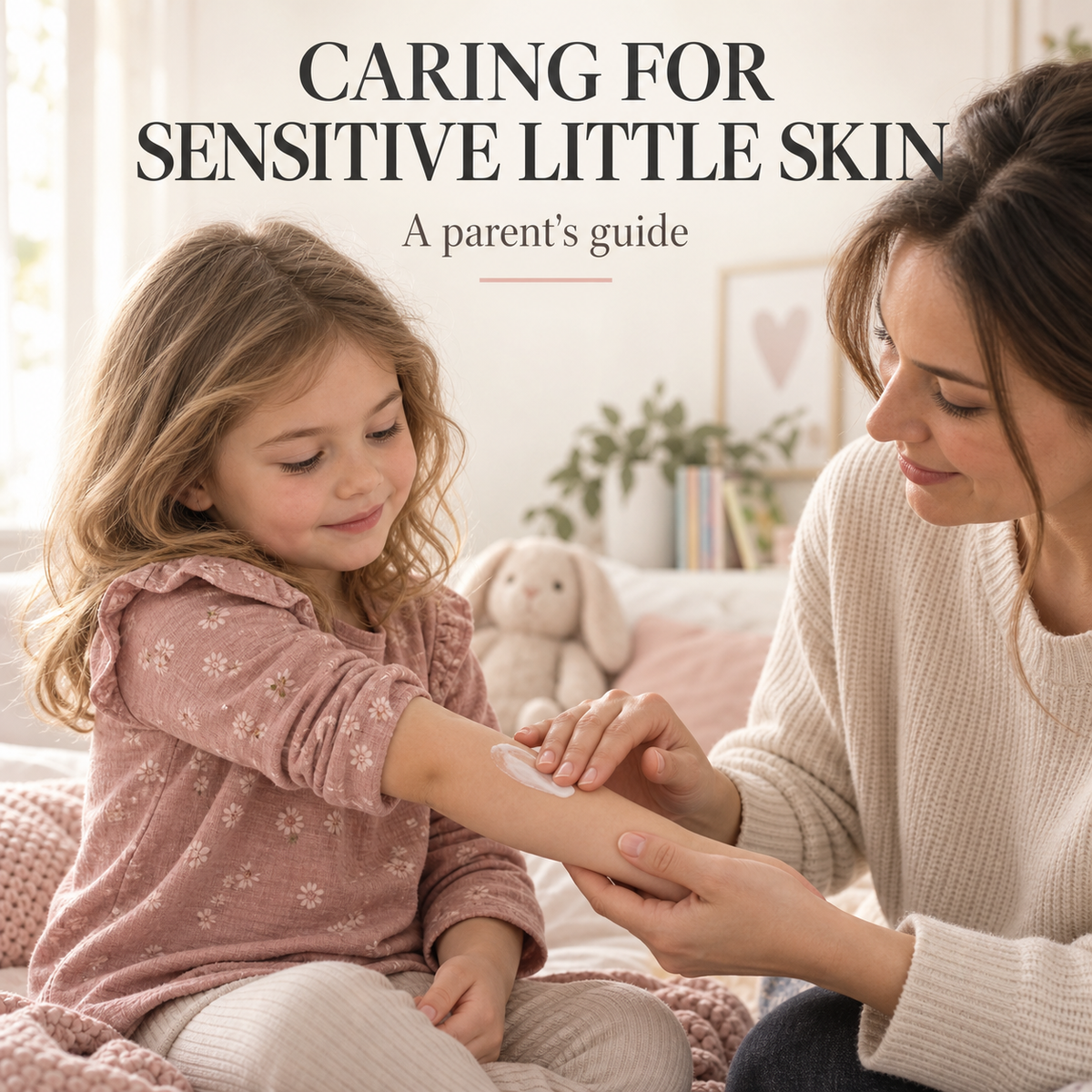
Moisturising Twice daily is the clinical recommendation for children with eczema. Use enough — a generous, visible layer is more effective than a thin film. Thick creams and ointments outperform thin lotions for barrier repair. Ensure the moisturiser is fragrance-free, free from food allergen derivatives, and preserved with well-tolerated preservatives.
Sun Protection Mineral sunscreen (zinc oxide or titanium dioxide) applied 15 minutes before sun exposure and reapplied every 2 hours. Avoid products with oxybenzone or other chemical UV filters. Hats, protective clothing, and shade are your allies.
Hand Hygiene Frequent handwashing dries and strips the skin barrier — choose fragrance-free, gentle soap and apply moisturiser after every wash. Consider a gentle hand cream in school bags for use after handwashing.
School and Social Considerations
Managing a child's allergen exposure outside the home requires communication and planning:
- Notify teachers and school nurses about your child's relevant allergens — including topical ones like nut oils sometimes found in art supplies
- Provide a named, allergen-safe sunscreen for use at school rather than a school-supplied product that may contain allergens
- Check the ingredients in shared hand sanitisers at school — many contain fragrance
- Art class: check for allergens in clay (some contain wheat), finger paints, and craft glue
- Sports: some sports creams and massage products contain nut oils — ensure coaches are aware
EpiLynx Kids Range
EpiLynx formulates a range of products specifically suited to children's skin — free from fragrance, nut oils, gluten, wheat derivatives, nickel, parabens, and all 14 most common contact allergens. Suitable from toddler age upward. Formulated without all food-allergen-derived ingredients. Pharmacist-formulated and independently reviewed.
A note for parents: the decisions you make about skincare in your child's early years genuinely matter for their long-term allergy and skin health trajectory. You are not being overcautious — you are being proactive about something that has solid science behind it.
Shop the EpiLynx Kids range at epilynx.com/collections/for-kids — allergen-free, pharmacist-formulated, and designed for the most sensitive young skin.