By Dr. Liia, PharmD — Pharmacist & Founder, EpiLynx by Dr. Liia | May 6, 2026 | 6 min read
Contact Dermatitis vs. Eczema: How to Tell the Difference — And the Allergen-Free Way to Manage Both
You have a rash. It itches. It's red. Is it eczema? Is it an allergic reaction? Is it something you put on your skin? Is it something you ate? The confusion is real — and extremely common, even among healthcare providers. As a pharmacist who formulates for allergy-prone and eczema skin, here is the clearest breakdown of these two frequently confused conditions.
The Fundamental Difference
Eczema (atopic dermatitis) is a chronic inflammatory skin condition with a genetic and systemic origin. It involves a structurally compromised skin barrier (often linked to filaggrin gene variants), an overactive immune response to otherwise harmless stimuli, and a persistent cycle of inflammation that can be triggered by many factors — allergens, stress, dry air, temperature changes, infections, and diet. Eczema doesn't have one single external cause that, once removed, makes it go away.
Contact dermatitis is a localized skin reaction to direct contact with a specific substance. It comes in two forms:
- Allergic contact dermatitis (ACD): a Type IV (delayed-type) immune response to a specific allergen — the immune system has been previously sensitized to the substance and reacts when re-exposed. Fragrance, nickel, preservatives, and latex are classic examples. Reactions typically appear 24–72 hours after contact.
- Irritant contact dermatitis (ICD): a non-immune-mediated reaction to a substance that directly damages the skin barrier — harsh surfactants, acids, solvents, or prolonged contact with water. No prior sensitization required; sufficient concentration or duration of exposure causes damage in anyone.
The critical practical distinction: contact dermatitis has an identifiable, removable cause. Remove the trigger, and the reaction clears. Eczema has many contributing factors, is chronic in nature, and doesn't resolve with any single elimination.
How to Tell the Difference: A Diagnostic Framework
Location and Pattern
| Eczema (Atopic Dermatitis) | Allergic Contact Dermatitis | |
|---|---|---|
| Classic locations | Inner elbows, behind knees, hands, face, neck — symmetrical distribution | Wherever the triggering product was applied — can be anywhere |
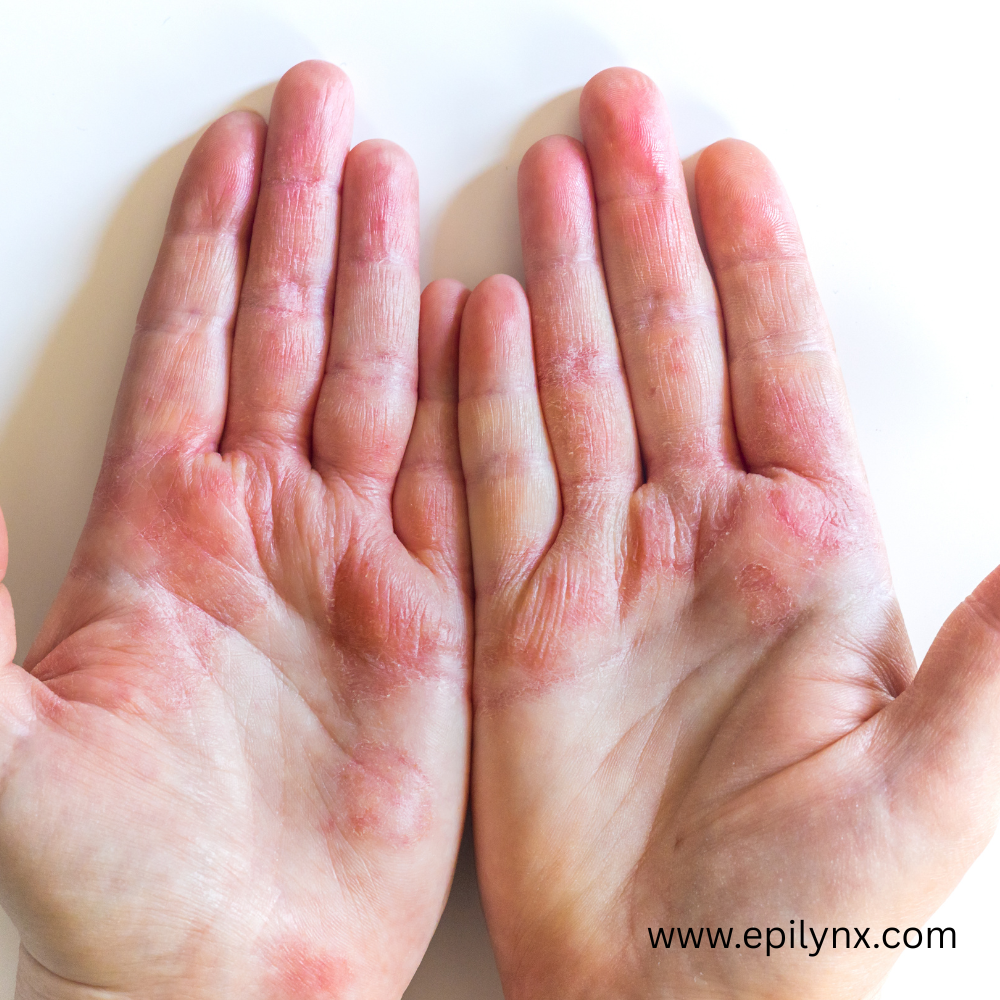
| Border | Often diffuse, poorly defined edges | Often has a distinct border matching product application area |
| Pattern | Chronic, recurring; may follow flare-remission cycle | Appears after specific exposure; resolves after trigger removed |
| Onset | Often present since childhood; chronic | Develops after sensitization; new in adults is common |
| Response to eliminating new product | May improve somewhat; other triggers remain | Significant improvement within days to 2 weeks |
| Associated history | Often: asthma, hay fever, food allergy ("atopic triad") | Prior exposure to allergen required; often occupational or product-related |
The Overlap Problem
The complication: these two conditions frequently co-exist. People with eczema have a damaged skin barrier that allows allergens to penetrate more easily — making them significantly more likely to develop allergic contact dermatitis on top of their baseline eczema. A person may have chronic eczema that is then being worsened by a fragrance contact allergy in their skincare — and the combination is far more severe than either condition alone.
For people with food allergies and celiac disease, this is particularly relevant: the same immune hyperreactivity that drives food allergies creates a predisposition to contact allergen sensitization. This population frequently has both conditions simultaneously.
The Most Common Skincare Contact Allergens
If you suspect your skincare products are causing or worsening your skin reaction, here are the most likely culprits — ranked by prevalence:
- Fragrance and parfum — the #1 contact allergen in cosmetics; responsible for the largest share of allergic contact dermatitis reactions
- Methylisothiazolinone (MI) and Methylchloroisothiazolinone (MCI) — preservatives; responsible for a significant wave of contact dermatitis outbreaks in the 2010s–2020s; still widely used
- Nickel and cobalt — metallic allergens present in cosmetic pigments; common cause of eyelid and periorbital contact dermatitis from eyeshadow
- Formaldehyde-releasing preservatives — DMDM hydantoin, quaternium-15, diazolidinyl urea; found in many conventional skincare products
- Propylene glycol — a common solvent and humectant; contact allergen in a subset of sensitive individuals
- Balsam of Peru — a complex botanical resin allergen that cross-reacts with fragrance, vanilla, cinnamon, and citrus; found in some "natural" skincare
- Chemical sunscreen filters — oxybenzone (benzophenone-3) is among the most allergenic sunscreen chemicals
- Food-derived ingredients — for people with food allergies: wheat protein (gluten for celiac), almond oil (tree nut), soy derivatives, and other food allergen-derived skincare ingredients can cause both contact sensitization and allergic reactions
Patch Testing: When and Why
If you have chronic contact dermatitis that isn't resolving despite eliminating obvious triggers, patch testing is the gold standard diagnostic tool. A dermatologist applies a standardized panel of 30–130 known contact allergens to adhesive patches placed on your back, leaving them for 48 hours. Readings at 48 and 96 hours identify which specific substances trigger a delayed allergic response.
Patch testing is especially valuable when:
- Your rash appears in unusual locations (eyelids, lips, neck) suggesting product contact
- You've eliminated obvious triggers but the rash persists
- You suspect multiple products are involved
- You have an occupational exposure component (hairdressers, healthcare workers, food service)
- Your reaction appeared after starting a new skincare or haircare product
Important: patch testing identifies Type IV (delayed, cell-mediated) hypersensitivity — it is a different test from IgE allergy blood tests or skin prick tests for food allergies. You may need both types of testing if you have both contact dermatitis and food allergies.
Managing Both Conditions: The Allergen-Free Strategy
Whether you have eczema, contact dermatitis, or both, the management foundation is the same — and it's what EpiLynx was built around:
- Eliminate all known contact allergens from your routine — starting with fragrance, MI/MCI, and your personal food allergen-derived ingredients
- Rebuild the skin barrier with ceramide-rich, allergen-free moisturizer applied immediately post-bathing and throughout the day on affected areas
- Use only fragrance-free, allergen-free products — every step of your routine; one fragranced product in a 10-product routine can undermine all the others
- Introduce new products one at a time with a one-week interval — this way, if a reaction occurs, you can identify the cause
- Patch test systematically on your inner wrist for 24–48 hours before applying any new product to your face
- Seek formal patch testing if your condition doesn't improve with allergen elimination
Shop EpiLynx sensitive skin collection — every product allergen-audited →
💡 The EpiLynx Advantage for Contact Dermatitis:
Most skincare requires you to audit every product individually. EpiLynx has already done the audit — every formula is free from fragrance, top 8 food allergens, gluten, MI/MCI, formaldehyde-releasers, and harsh preservatives. For people managing contact dermatitis alongside food allergies or celiac disease, this removes an enormous investigative burden.
Frequently Asked Questions
What is the difference between contact dermatitis and eczema?
Eczema is a chronic genetic condition with a compromised skin barrier and immune dysregulation. Contact dermatitis is a localized reaction to a specific external substance — either allergen-triggered (allergic) or directly damage-causing (irritant). Key tell: contact dermatitis improves when the trigger is removed; eczema is chronic with many contributing factors. Many people have both simultaneously.
How do I know if my skin reaction is contact dermatitis or eczema?
Contact dermatitis: appears where a product was applied, often has a sharp border, improves significantly when that product is removed. Eczema: appears in classic locations (inner elbows, behind knees), is chronic and cyclical, influenced by many factors. A dermatologist can diagnose with confidence; patch testing identifies specific contact allergens.
What are the most common causes of contact dermatitis from skincare?
Fragrance (#1), methylisothiazolinone (MI/MCI), nickel in cosmetic pigments, formaldehyde-releasing preservatives, propylene glycol, oxybenzone in chemical sunscreens, and food allergen-derived ingredients (wheat, nuts, soy) for people with food allergies.
What is patch testing and should I get it?
Patch testing applies known contact allergens to your back for 48+ hours to identify which specific substances cause allergic contact dermatitis. Recommended when contact dermatitis doesn't resolve with standard elimination. Ask your dermatologist for a referral. Shop EpiLynx allergen-free sensitive skin products →
Stop Playing Ingredient Detective. Start With Products Already Cleared.
EpiLynx eliminates the most common skincare contact allergens from every formula — pharmacist-formulated, gluten-free, allergen-free, fragrance-free. One less variable in a complex equation.
Shop Sensitive Skin → Find My Routine →Use code EPILYNXGLOW35 for 35% off · Free shipping on orders $24+