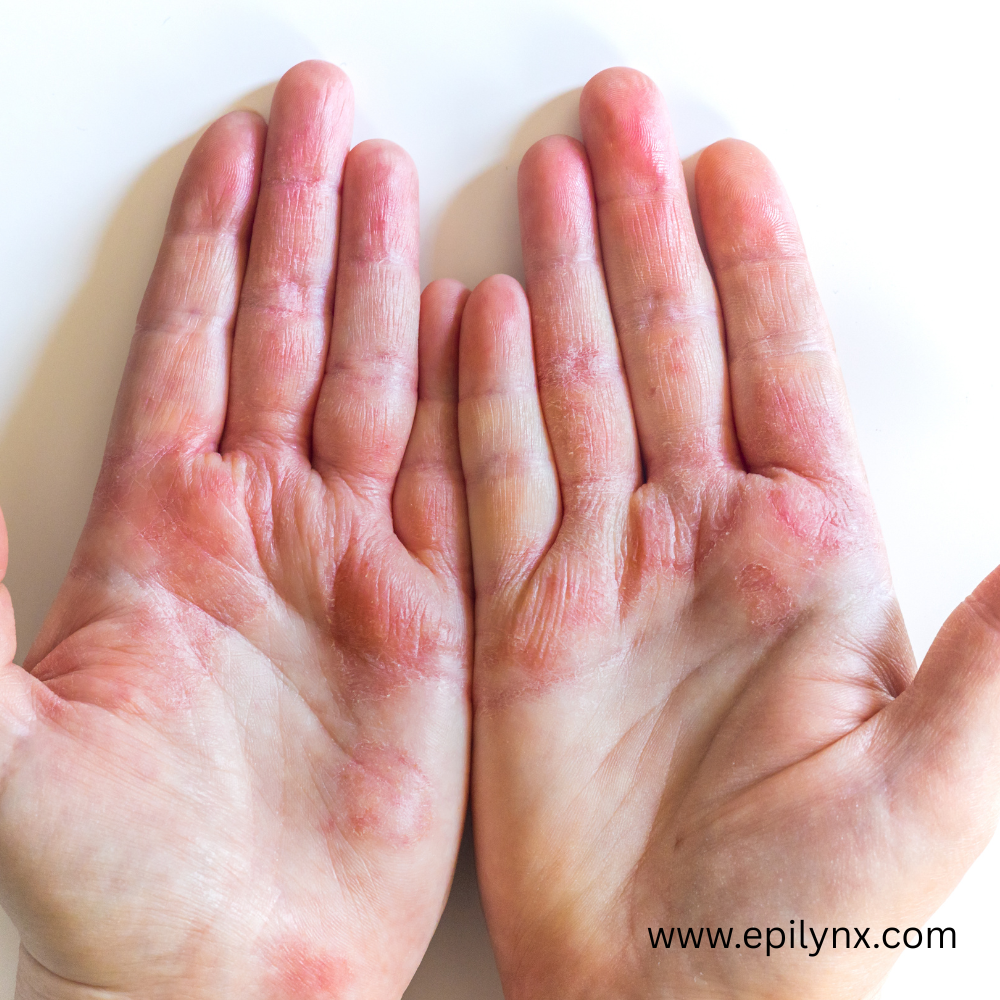

Perimenopause & Menopause Skin: The Allergen-Free Solution
By Dr. Liia Ramachandra, PharmD, PhD — pharmacist, formulator and founder of EpiLynx. 6 min read.
Your skincare worked for decades. Then perimenopause arrived and nothing worked anymore — your reliable moisturizer now stings, the serum you loved is causing redness, and your skin seems inexplicably reactive to things it tolerated for years. This isn’t your skin failing you. It’s your skin’s biology changing. And for women with celiac disease or food allergies, the shift can be dramatic. Here’s what’s happening — and how to respond.
What estrogen was doing for your skin, and what happens when it declines
Estrogen is one of the most important regulators of skin health. Beyond its reproductive roles, estrogen:
- Stimulates collagen production — it activates fibroblasts to produce Types I and III collagen; skin loses roughly 30% of its collagen in the first five years after menopause.
- Supports sebum production — it maintains the lipid component of the barrier; as it declines, skin becomes drier, more fragile and more prone to transepidermal water loss.
- Maintains skin thickness — postmenopausal skin is measurably thinner and more vulnerable to physical and environmental damage.
- Regulates wound healing — postmenopausal skin repairs more slowly, meaning every eczema flare or allergic reaction takes longer to resolve.
- Modulates immune and inflammatory responses — its decline can unmask or amplify rosacea, eczema and contact dermatitis.
The perimenopause transition can begin in the early-to-mid 40s and last a decade before full menopause. Many women first notice their skin becoming more reactive, drier and less predictable during perimenopause, often years before other symptoms appear.
The single most useful early change is moving from a lotion to a genuinely ceramide-rich cream. Our Miracle Face Cream is the weight most women need to step up to, and it is fragrance-free — which matters more now than it did at 35.
The celiac disease and menopause interaction: a double challenge
For women who have celiac disease or food allergies, the menopausal skin transition presents compounded challenges that are almost never addressed in mainstream menopause skincare advice.
Amplified skin reactivity
Estrogen decline weakens the skin barrier — the same structural weakness already present in celiac and allergy-prone skin. The result: skin that was already reactive becomes significantly more so. Products that were borderline tolerable may become triggers. Ingredients that never caused issues before may begin to. The allergen-free standard that mattered before menopause becomes even more critical during it.
Nutrient depletion — a compounding problem
Celiac disease impairs absorption of calcium, vitamin D, zinc and essential fatty acids — nutrients already in elevated demand during menopause. Calcium and vitamin D support bone density during estrogen-related bone loss. Zinc is critical for barrier integrity and collagen synthesis. Essential fatty acids maintain the barrier lipid matrix that estrogen previously supported.
Rosacea emergence and worsening
Rosacea frequently first appears — or dramatically worsens — during perimenopause. Hot flashes create the same vasodilation pattern that triggers rosacea flushing, and estrogen decline affects the vascular regulation that keeps it under control. For the redness that emerges here, our Cooling Calming Nurturing Face Cream is formulated specifically for redness relief and works better still kept in the fridge.
Dermatitis herpetiformis and hormonal shifts
Women with celiac disease and DH sometimes report changes in presentation during hormonal transitions. The research on this specific interaction is limited, but the clinical observation aligns with the broader pattern. Strict gluten-free diet and gluten-free skincare remain the primary management strategies throughout.
What menopausal skin actually needs — versus what it is being sold
Menopause skincare is one of the fastest-growing beauty segments. Unfortunately, many products entering this space contain the same fragranced, allergen-laden formulas as conventional skincare — just repackaged in softer colours with the word "menopause" on the label.
Ceramides — more critical than ever
As estrogen declines, the skin’s ability to synthesise barrier lipids independently decreases. Topical ceramide delivery becomes the primary intervention to replace what the body can no longer adequately produce. Apply twice daily rather than once.
Peptides — the collagen replacement strategy
Peptides signal fibroblasts to produce collagen and elastin, compensating for the estrogen-driven stimulus that is now declining. They are notably well tolerated, which makes them useful where retinoids are not. Our Sunrise Nourishing Firming Serum is the step for this.
Hyaluronic acid — address dramatically increased dryness
Water loss rises substantially after estrogen decline. A humectant layer replaces the moisture-retaining function estrogen previously supported. Layer it under a ceramide cream — applied to damp skin, never dry.
Niacinamide — manage emerging rosacea and redness
Niacinamide addresses the redness, flushing and reactivity that frequently emerges during perimenopause. Anti-inflammatory, barrier-strengthening and collagen-supporting, with very low irritation risk.
Vitamin C — antioxidant defence against accelerated ageing
UV damage and oxidative stress accelerate all estrogen-related collagen loss. A morning vitamin C serum provides antioxidant protection. Use a stable, non-irritating form on skin that is now more reactive — our Brightening Vitamin C Serum is built for exactly that.
Richer moisturisers, evening especially
Menopausal skin often needs richer formulas than your premenopausal routine provided. If your previous moisturiser now feels insufficient, that is normal — not product failure. Nourishing & Firming Face Cream for evening, something lighter for daytime under SPF.
Daily mineral SPF — non-negotiable
UV accelerates every menopausal skin change: collagen loss, pigmentation and barrier weakening are all compounded by sun exposure. For rosacea emerging during menopause, zinc oxide is additionally valuable for its anti-inflammatory properties. SPF 50 Mineral Moisturizer is the daily one.
What to eliminate during the transition
- Fragrance — heightened reactivity makes fragrance contact allergy more likely to develop or worsen. This is not the time to introduce new scented products.
- Harsh exfoliants — on a thinner barrier, over-exfoliation can set off prolonged inflammatory responses. Swap to enzyme exfoliants or very low-concentration PHAs.
- High-concentration retinoids without barrier preparation — retinoids help menopausal collagen loss but need very gradual introduction. Build over months, buffered over moisturiser.
- Alcohol-based toners and serums — menopausal dry, reactive skin cannot tolerate alcohol denat.
- All gluten and food allergen-derived ingredients — the same vigilance as always, now with skin that is more permeable than it has ever been.
What I actually reach for
- Lifting and Firming Face & Neck Cream — for the face and neck thinning that accelerates after menopause.
- Sunrise Nourishing Firming Serum — the peptide and humectant step.
- Brightening & Radiant Under-Eye Cream — the under-eye thins earliest.
- Miracle Face Cream — the ceramide-rich daily layer.
- SPF 50 Mineral Moisturizer — every morning, without exception.
All fragrance-free, gluten-free from raw material to finished goods, and free of our 14 excluded allergens. Shipping is free over $39, and EPILYNXGLOW25 takes 25% off if you are rebuilding a routine.
Frequently asked questions
What happens to skin during perimenopause and menopause? Declining estrogen causes roughly 30% collagen loss in the first five years post-menopause, increased dryness, a thinner and more permeable barrier, slower healing, and amplified inflammatory conditions including rosacea, eczema and contact dermatitis.
Why does skin become more sensitive and reactive during menopause? Estrogen maintains barrier lipid production, collagen and immune regulation. As it declines the barrier weakens, becoming more permeable to allergens and mounting exaggerated responses to previously tolerated ingredients.
Can celiac disease worsen during menopause? The interaction is under-researched but clinically relevant. Estrogen decline can increase intestinal permeability, and menopausal nutrient demands compound celiac malabsorption of calcium, vitamin D and zinc.
What are the best ingredients for menopausal skin? Ceramides, peptides, hyaluronic acid, niacinamide, stable vitamin C and daily mineral SPF — all fragrance-free and allergen-free.
Should I start a retinoid at this stage? It is the best-evidenced topical for collagen, but menopausal skin is thinner and more reactive. Two nights a week, buffered over moisturiser, sustained for a year beats nightly use abandoned in a fortnight.
Keep reading
- Menopause and Your Skin: The Full Timeline
- What Estrogen Actually Does for Your Skin
- The Complete Perimenopause Skincare Routine
- Collagen After Menopause: What Rebuilds It
Written by Dr. Liia, PharmD, for educational purposes only. Not medical advice. Discuss menopausal hormone therapy and skincare changes with your OB-GYN and dermatologist.