Article: The Skincare Label Decoder: How to Read Ingredients Like a Pro (and Stop Being Fooled)
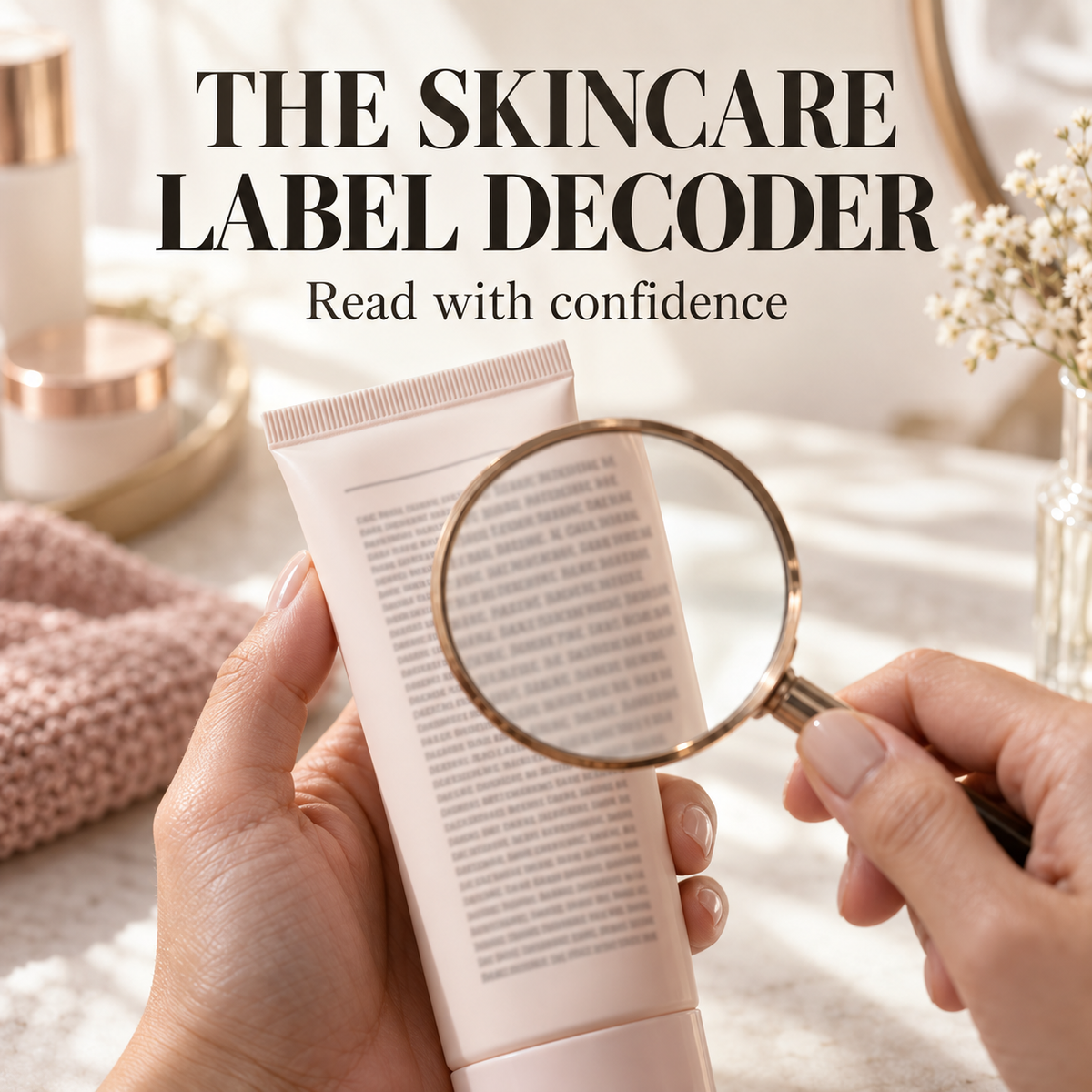
The Skincare Label Decoder: How to Read Ingredients Like a Pro (and Stop Being Fooled)
If You Can’t Pronounce It, Don’t Panic 🧴
Have you ever flipped over a skincare bottle and thought,
“Is this a moisturizer or a chemistry test?”
Don’t worry — you’re not alone.
Skincare labels can feel like hieroglyphics. But here’s the truth: the secret to protecting your skin is hiding in plain sight — right on the label.
The problem? Most brands make it hard on purpose. Words like “hypoallergenic,” “natural,” and “clean” don’t mean what you think they do.
So today, we’re decoding the fine print — the hidden allergens, the fake claims, and the red flags dermatologists want you to know.
By the end of this guide, you’ll read labels like a pro… and your skin will thank you.
1. First Rule: Ingredients Are Listed by Quantity (Not Randomly)
Skincare ingredients are listed in order of concentration.
That means the first 5 ingredients make up the bulk of the product — and they tell you a lot about what you’re putting on your skin.
📌 If the first few words are “aqua, alcohol, fragrance,” your skin barrier just screamed a little.
What you want to see in the top 5:
-
Water or aloe (hydrating base)
-
Glycerin or squalane (moisture-locking)
-
Niacinamide or hyaluronic acid (barrier support)
-
Gentle emulsifiers (no PEGs or SLS!)
2. The Big Red Flags to Watch For 🚨
These are the top offenders dermatologists and allergists warn against — especially for sensitive or allergen-prone skin.
❌ Fragrance or Parfum
= mystery chemicals. Causes 60% of allergic reactions.
❌ Hydrolyzed Wheat Protein or Triticum Vulgare
= gluten! Can trigger inflammation or dermatitis.
❌ Glycine Soja, Soy Lecithin, Soybean Oil
= soy derivatives linked to allergies and hormonal sensitivity.
❌ Sweet Almond Oil, Macadamia, Argan Oil
= nut-based oils, not safe for nut allergies.
❌ Essential Oils (Lavender, Citrus, Peppermint)
= natural, yes. Gentle? No. Major contact irritants.
❌ DMDM Hydantoin, Quaternium-15
= formaldehyde-releasing preservatives.
❌ “Color + Number” (FD&C Red 40, Yellow 5)
= synthetic dyes that can trigger rashes or migraines.
📌 Pro tip: If it smells like flowers and glitters like fairy dust, it probably isn’t good for your barrier.
3. “Hypoallergenic” and “Dermatologist-Tested” Mean… Nothing 😬
These words aren’t legally defined.
Any brand can use them — even if the product contains allergens.
-
“Hypoallergenic” ≠ free of allergens.
-
“Dermatologist-tested” ≠ approved or safe.
📌 Translation: “We showed this to a dermatologist once, and they didn’t cry.”
The only labels that mean something are certified allergen-safe, gluten-free, and fragrance-free — like every EpiLynx product.
4. The “Natural” Trap 🌿
Natural doesn’t always mean safe — poison ivy is natural, too.
Common “natural” ingredients that trigger reactions:
-
Coconut derivatives (can clog pores)
-
Citrus oils (cause photosensitivity)
-
Tea tree and peppermint oils (irritating for eczema and rosacea)
📌 Real clean beauty = science-backed, allergy-safe, non-toxic.
5. The Hidden Gluten Problem 🌾
Gluten can sneak into your skincare through:
-
Hydrolyzed wheat protein
-
Barley extract
-
Oat derivatives (if not certified gluten-free)
It’s especially risky in lipsticks, creams, and serums that touch the mouth or hands — because gluten can be ingested in trace amounts.
📌 EpiLynx = 100% gluten-free, clinically tested for celiac and autoimmune safety.
6. Decoding the Latin: What Those Fancy Names Really Mean 🧠
Here’s a quick cheat sheet for the top 10 confusing terms you’ll see:
| Label Term | What It Actually Means | Should You Worry? |
|---|---|---|
| Aqua | Water | ✅ Safe |
| Butyrospermum Parkii | Shea butter | ⚠️ Nut-derived (avoid if allergic) |
| Triticum Vulgare | Wheat (gluten) | 🚫 Avoid |
| Cetearyl Alcohol | Fatty alcohol (moisturizer) | ✅ Safe |
| Phenoxyethanol | Preservative | ⚠️ Low-risk, but not for hypersensitive skin |
| Limonene, Linalool, Citral | Fragrance components | 🚫 Avoid |
| Glycine Soja | Soybean | 🚫 Avoid |
| CI + Number | Synthetic colorant | ⚠️ Possible irritant |
| Sodium Lauryl Sulfate (SLS) | Harsh foaming agent | 🚫 Avoid |
| Squalane | Plant-based moisturizer | ✅ Safe & amazing |
📌 Bookmark this table. It’ll save your skin (literally).
7. Watch for Greenwashing: Marketing Buzzwords That Trick You 🍃
Brands love to throw around words that sound safe:
| Marketing Term | What It Actually Means |
|---|---|
| “Natural” | Undefined. Can still contain allergens. |
| “Clean” | Trendy, but not regulated. |
| “Organic” | Sometimes true, but can still cause reactions. |
| “Unscented” | May contain masking fragrances. |
| “Vegan” | Animal-free, but not always allergen-free. |
| “Cruelty-Free” | No animal testing, but ingredient safety can vary. |
📌 The only term that truly means safety? Allergen-safe.
No marketing spin. Just science.
8. How to Read Like a Dermatologist 🩺
Next time you pick up a product, do this:
-
Flip the bottle.
-
Read the first 5 ingredients.
-
Scan for red flags (fragrance, gluten, soy, nuts).
-
Look for allergy-safe certifications.
-
If in doubt — Google the INCI (International Nomenclature) name.
📌 You don’t need to memorize Latin. Just learn your triggers.
9. Why EpiLynx Labels Look So Simple (On Purpose)
Transparency is a form of trust.
That’s why EpiLynx labels are clean, direct, and easy to read — because skincare shouldn’t require a chemistry degree or a magnifying glass.
Every EpiLynx product is formulated without:
-
Gluten
-
Nuts
-
Soy
-
Dairy
-
Fragrance
-
Alcohol
-
Parabens
-
Sulfates
It’s not about being fancy — it’s about being honest.
10. The Power of Knowing What You’re Using 💚
Once you learn to decode labels, you’ll never shop the same way again.
You’ll feel empowered, informed, and allergy-safe — and your skin will reward you with calm, healthy confidence.
Because true beauty isn’t in the marketing.
It’s in the knowledge you hold and the care you choose.
The Epilynx Promise
At EpiLynx, transparency isn’t optional — it’s our foundation.
We believe skincare should be safe, smart, and accessible for everyone.
Every formula is:
🌾 Gluten-Free
🥜 Nut-Free
🥛 Soy & Dairy-Free
🌱 Vegan
🐰 Cruelty-Free
💧 Fragrance & Essential Oil-Free
💚 Allergen-Safe for Sensitive Skin
Because when you can read every ingredient and trust every word — that’s real confidence.
Final Thought: Knowledge Is Your Best Skincare Tool 🧠✨
The beauty industry thrives on confusion.
EpiLynx thrives on clarity.
When you understand what’s on your label, you take back control of your skin — and that’s the most powerful glow there is.
So grab your moisturizer, flip that label, and let’s make skincare smarter together.
Call to Action
✨ Decode your skincare with confidence. Explore the EpiLynx Allergen-Safe Collection — where clarity meets clean beauty, and every ingredient has your trust.