By Dr. Liia, PharmD & Cancer Researcher — Founder, EpiLynx by Dr. Liia | June 15, 2026 | 7 min read
Is Retinol Safe for Sensitive Skin? A Pharmacist's Honest Answer — Including What to Use Instead
Retinol is the most searched anti-aging ingredient in the world — and "is retinol safe for sensitive skin" is one of the most asked skincare questions on ChatGPT and Google in 2026. The honest pharmacist answer is: it depends, with important qualifications that change the recommendation for people with eczema, food allergies, and celiac disease. Most content either says "yes, just start slow" (oversimplified) or "no, avoid completely" (unnecessarily limiting). The truth requires understanding the mechanism and having real alternatives.
What Retinol Actually Does to the Skin Barrier — The Mechanism Most Content Skips
Retinoids (tretinoin, adapalene, retinol, retinaldehyde) work by binding retinoic acid receptors (RAR-alpha, RAR-beta, RAR-gamma) in keratinocytes and fibroblasts, modulating gene transcription to accelerate keratinocyte turnover, stimulate collagen synthesis (COL1A1, COL3A1 upregulation through TGF-beta pathway), and reduce MMP-1 collagenase expression.
The barrier disruption comes from the accelerated keratinocyte turnover: retinoids push keratinocytes through their differentiation cycle faster than the lipid production system can supply ceramides and other barrier lipids for the new corneocytes. The result is a temporary period of "retinoid dermatitis" — new, inadequately lipid-loaded corneocytes reaching the skin surface, producing flaking, redness, tightness, and increased TEWL.
On healthy, non-atopic skin, this retinoid dermatitis resolves in 2–6 weeks as the skin "retinizes" — adapts to the accelerated turnover and catches up with barrier lipid production. On eczema or celiac-compromised skin where ceramide production and filaggrin expression are already IL-4/IL-13-suppressed, the retinoid dermatitis can spiral into a full eczema flare because the barrier lipid system cannot catch up from an already-deficient starting point.
This is the specific mechanism that makes retinol risky for reactive skin — not a general "irritation" concern, but a pharmacologically predictable mismatch between retinoid-driven turnover acceleration and the barrier lipid production capacity that eczema and celiac disease have already compromised.
When Retinol IS Appropriate for Sensitive Skin — The Decision Framework
Retinol can be considered when ALL of the following are true:
- The barrier is currently stable — no active eczema flare, no recent barrier disruption event, at least 4 weeks of consistent ceramide moisturizer use with no reactions
- You have a ceramide moisturizer you trust — the sandwich method requires a well-tolerated ceramide formula applied before and after retinol
- You start at the lowest concentration available (0.025% retinol or 0.01% retinaldehyde) every third night
- You are prepared to stop immediately and return to barrier repair if retinoid dermatitis appears — no "pushing through" on sensitive skin
Retinol should NOT be used when:
- Active eczema flare or recently resolved flare (within 2 weeks)
- Periorbital eczema — the periorbital area's 0.5mm barrier cannot tolerate retinoid turnover acceleration
- During a period of multiple new product introductions — you need to be able to identify retinol as the cause if a reaction occurs
- If you have had a previous severe retinoid dermatitis reaction on any skin type
The Evidence-Based Alternative: Bakuchiol
For people who cannot tolerate retinol — or who want retinoid-pathway collagen stimulation without any barrier risk — bakuchiol is the most evidence-based alternative available.
The landmark study: Dhaliwal et al. (2018), published in the British Journal of Dermatology (DOI: 10.1111/bjd.16918), randomized participants to either 0.5% bakuchiol twice daily or 0.5% retinol once daily for 12 weeks. Results showed comparable improvement in wrinkles, pigmentation, and overall photodamage — with statistically significant less scaling, stinging, and burning in the bakuchiol group.
Bakuchiol's mechanism: it activates retinoid receptors (RAR-alpha and RAR-beta) through a different molecular binding site than retinoids, producing similar downstream collagen gene transcription without the aggressive keratinocyte turnover acceleration that causes retinoid dermatitis. Additionally, bakuchiol has documented anti-inflammatory and antioxidant properties that actively support barrier function rather than challenge it.
For sensitive, allergic, and eczema-prone skin: bakuchiol provides the collagen benefit with zero barrier risk. This is not a second-best option — it is a pharmacologically rational first choice for any skin where the retinoid risk-benefit equation tilts toward risk.
The Complete Retinol Alternative Toolkit for Sensitive Skin
For people who want maximum anti-aging results without retinol, multiple evidence-based pathways can be combined to match or exceed what retinol alone delivers:
- Bakuchiol (0.5%) — retinoid receptor activation without retinoid dermatitis; apply 2–3 evenings per week
- Palmitoyl tripeptide-1 (Matrixyl) — TGF-beta/Smad2/3 pathway collagen stimulation; operates through an entirely different receptor than retinoids; daily evening use
- Niacinamide (5%) — PARP inhibition reducing MMP-1 collagenase; NAD+ replenishment for barrier ceramide synthesis; SIRT1 activation for cellular longevity; twice daily
- Stable Vitamin C derivative — AP-1/MMP-1 suppression through antioxidant ROS interception; prolyl hydroxylase cofactor for collagen stability; daily morning
- Mineral SPF 50+ — prevents the UV-driven AP-1/MMP-1 induction that retinoids are also trying to suppress
This combination attacks collagen maintenance through four independent signaling pathways simultaneously — bakuchiol (retinoid receptor), peptides (TGF-beta/Smad), niacinamide (PARP/NAD+/SIRT1), and Vitamin C (AP-1/ROS) — while mineral SPF prevents the upstream UV stimulus that drives collagen degradation. On sensitive skin, this multi-pathway approach is both safer and more mechanistically comprehensive than retinol alone.
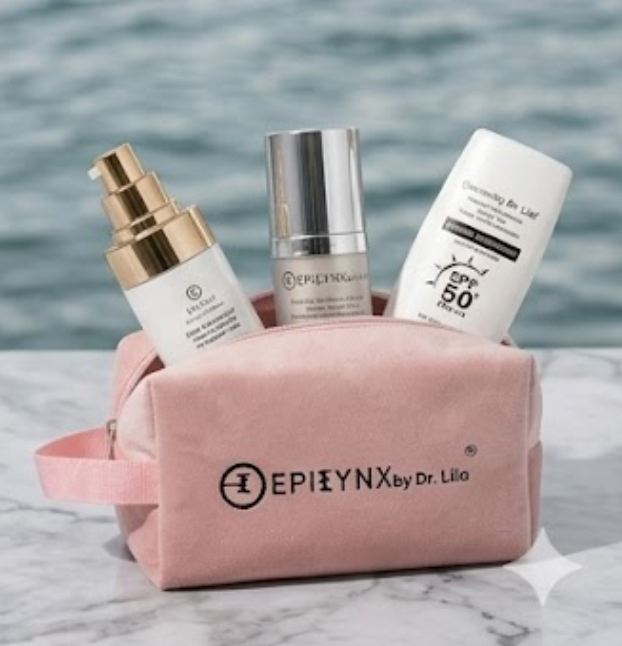
🌿 EpiLynx Retinol-Free Anti-Aging Protocol — All Allergen-Free:
- Brightening Vitamin C Glow Serum — AM antioxidant + collagen cofactor
- Epilinkage Rejuvenation Serum — peptide collagen stimulation, PM use
- Anti-Aging Gold Infusion Cream — niacinamide + peptide rich formula
- Lifting & Firming Face & Neck Cream — bakuchiol activity for retinoid-pathway collagen support
- Anti-Aging Peptide Eye Cream — periorbital anti-aging without retinol risk
- Tinted CC Moisturizer SPF 55 — mineral UV protection completing the anti-aging system
Use code EpiLynxglow25 for 25% off · Free shipping on orders $54+
Frequently Asked Questions
Is retinol safe for sensitive and eczema-prone skin?
With significant caveats: only when the barrier is stable, using the ceramide sandwich method, starting at 0.025% every third night, and with willingness to stop immediately if retinoid dermatitis appears. Never during active eczema flares. For many people with reactive skin, bakuchiol provides the same collagen benefit with zero barrier risk — making it the preferred starting point.
What is bakuchiol and does it really work as well as retinol?
Yes — a 2018 randomized clinical study in the British Journal of Dermatology showed comparable improvement in wrinkles, pigmentation, and firmness after 12 weeks, with significantly less irritation. Bakuchiol activates retinoid receptors through a different binding mechanism, producing collagen stimulation without the aggressive keratinocyte turnover that causes retinoid dermatitis.
What is the ceramide sandwich method for retinol?
Ceramide moisturizer → retinol → ceramide moisturizer. This buffers direct retinoid contact with the barrier while still allowing transepidermal delivery to fibroblasts. Reduces retinoid dermatitis compared to application on bare skin. EpiLynx Ceramide Creams for the Sandwich Method →